
Tennessee Juvenile Law Update

Tennessee Juvenile Law Update

Tennessee Juvenile Law Update: Efforts to Treat More Juveniles Charged with Crimes as Adults

A bill is working its way through the Tennessee General Assembly that would change the way the State of Tennessee treats juveniles charged with certain crimes.

Current Law

Presently in Tennessee, when a child is charged with a crime, the child is under the jurisdiction of the juvenile court system. There, the focus is on rehabilitation. In some cases involving certain serious crimes, a prosecutor can request that the juvenile court judge transfer the child to adult court where the focus is on punishment.

More specifically, a juvenile is now only eligible for a transfer if the child was:

(i) Less than fourteen (14) years of age at the time of the alleged conduct and charged with first degree murder or second degree murder or attempted first or second degree murder;

(ii) Fourteen (14) years of age or more but less than seventeen (17) years of age at the time of the alleged conduct and charged with the offense of first degree murder, second degree murder, rape, aggravated rape, rape of a child, aggravated rape of a child, aggravated robbery, especially aggravated robbery, aggravated burglary, especially aggravated burglary, kidnapping, aggravated kidnapping, especially aggravated kidnapping, commission of an act of terrorism, carjacking, or an attempt to commit any such offenses;

(iii) Sixteen (16) years of age or more at the time of the alleged conduct and charged with the offense of robbery or attempt to commit robbery; or

(iv) Seventeen (17) years of age or more at the time of the alleged conduct;

Tenn. Code Ann. § 37-1-134(a)(1)(A).

If a prosecutor requests a transfer and the juvenile is eligible, a full hearing is then required wherein a juvenile court judge must determine whether transfer is appropriate. Such transfer is only appropriate if the court finds that there is probable cause to believe that the child committed the delinquent act, the child is not committable to an institution for the developmentally disabled or mentally ill; and the interests of the community require that the child be put under legal restraint or discipline. Tenn. Code Ann. § 37-1-134(a)(4).

In order to make the “interests of the community” determination, a juvenile court judge has broad discretion and considers the following factors involving both the nature of the crime and the child’s character and history:

  1. The extent and nature of the child’s prior delinquency records;
  2. The nature of past treatment efforts and the nature of the child’s response thereto;
  3. Whether the offense was against a person or property, with greater weight in favor of transfer given to offenses against the person;
  4. Whether the offense was committed in an aggressive and premeditated manner;
  5. The possible rehabilitation of the child by use of procedures, services and facilities currently available to the court in this state;
  6. Whether the child’s conduct would be a criminal gang offense, as defined in § 40-35-121, if committed by an adult; and
  7. Whether the child has a history of trauma or abuse, including, but not limited to, the child being a victim of a human trafficking offense as defined in § 39-13-314.

Tenn. Code Ann. § 37-1-134(b). Simply put, the juvenile court judge looks at the big picture and applies their training and expertise in working with children to determine whether the child is capable of rehabilitation or needs to be transferred to adult court.

Proposed Legislation

House Speaker Cameron Sexton has introduced a bill that would reverse the current process, taking away the discretion of juvenile court judges and sending children charged with certain crimes directly to adult court.

Under this proposed legislation, children accused of certain serious crimes would be immediately placed in the adult court system. The crimes are the same as those making a juvenile eligible for transfer now with two additions:

  • Transfer required for children aged 14 to less than 17 at the time of alleged aggravated battery when the victim is less than thirteen (13) years of age; and
  • Transfer required for children aged sixteen (16) years or more at the time of the alleged conduct and charged with any offense if a deadly weapon was used during the commission of the offense.

H.B. 1029, Amendment 4849, 113th Tenn. Gen. Assembly (2023), amending Tenn. Code. Ann. § 37-1-134(a)(1)(B).

The pending legislation then requires the criminal court judge to decide if the child remains in criminal court. The law, as drafted, mandates that the child be tried as an adult in criminal court if the criminal court finds probable cause to believe that:

  1. The child committed the delinquent act as alleged;
  2. The child is not committable to an institution for the developmentally disabled or mentally ill; and
  3. The interest of the community requires that the child be put under legal restraint or discipline.

H.B. 1029, Amendment 4849, 113th Tenn. Gen. Assembly (2023), amending Tenn. Code Ann. § 37-1-134(b)(1).

And, in considering the “interest of the community” the criminal court judge is only instructed to consider the nature of the crime itself and whether the child has been a victim of human trafficking. Otherwise, the history and characteristics of the child (and whether they are candidates for rehabilitation) are not considered. More specifically, criminal court judges are only required to consider:

  1. Whether the offense was against a person or property, with greater weight in favor of a determination that the child shall be tried as an adult in criminal court if the offense was against a person;
  2. Whether the offense was committed in an aggressive and premeditated manner;
  3. Whether the child’s conduct would be a criminal gang offense, as defined in 40-35-121, if committed by an adult; and
  4. Whether the child’s history demonstrates the child is, or has been, a victim of human trafficking.

H.B. 1029, Amendment 4849, 113th Tenn. Gen. Assembly (2023), amending Tenn. Code Ann. § 37-1-134(b)(2). So, while the criminal court judge could theoretically transfer a case to juvenile court, such transfers would be rare.

Reasons for the Proposed Change

As for why this drastic change is being proposed, Speaker Sexton said he is concerned juveniles do not have penalties as harsh as adults and said he believes he is seeing an increase in crimes committed by juveniles statewide1. However, no statewide statistics have been provided and the proponents of the bill appear instead to be focused on Memphis.

Representative Mary Littleton (Dickson) presented the bill on behalf of House Speaker Sexton to the Criminal Justice Subcommittee on March 14, 2023 and relied wholly on a set of statistics out of Shelby County. According to her, in 2021 the juvenile system in Shelby County saw 2,507 teens — 520 of whom were charged with a second offense, and “all the way down to the 10th” offense. Representative Littleton stated 123 teens were charged with a 10th offense.2

At the subcommittee meeting, Representative Joe Towns, Jr. (Memphis) asked for juvenile offender data from other areas of the state and Rep. Littleton had none. When asked, Rep. Littleton offered no information about juvenile court programs that were working well either.

Response & Concerns

First-Hand Account: Juvenile Justice Advocate Testifies Against Passage

At the March 14th subcommittee hearing, Cyntoia Brown testified against its passage. Now a juvenile justice advocate, Ms. Brown spoke about her own experience after she was charged with murder and robbery as a 16-year-old in 2004. At the time, she told the court she was being sex trafficked. Ms. Brown was transferred to be tried as an adult.

“I was one of those kids. I was transferred to be tried as an adult. I was removed from the juvenile justice center and sent to an adult jail and I had to spend two years in solitary confinement because whenever a juvenile is sent to a facility they have to be kept away site and sound from all of the adults. The only option that the sheriffs really have is to place them in solitary confinement, so for 23 hours a day I was kept in a cell, and most days the only sunlight I saw was through a window in a wall and the only human interaction I had was from a guard who was bringing me my food tray” explained Ms. Brown.3

Ms. Brown explained that she had several mental breakdowns as a result of solitary confinement and was unable to participate in her own defense. And, Ms. Brown talked about the lack of education juveniles receive behind bars in adult facilities, as she pointed back to her time behind bars and how her lawyer would drop off educational materials.

“[A] child who’s kept in the juvenile system can have opportunities to progress can have an opportunity to be transformed, and retrained and become a benefit to society, but a child who is placed in an adult system is pretty much just set on a downhill path,” explained Brown.4

When asked about her time in the juvenile court system twenty years ago, Ms. Brown testified that the Department of Children’s Services offered very few services. She is now more optimistic under the leadership of Director Quinn. However, Ms. Brown encouraged more investment on the juvenile justice side stating that current juvenile justice programs are effective if they are funded properly.

Juvenile Court Judges’ Expertise Overlooked

At the March 14th subcommittee meeting, Representative Gloria Johnson (Knoxville) expressed her concerns about the proposed change and stressed that juvenile judges are the most trained and qualified and “the best people to hear juvenile cases.”

Similarly, Kathy Sinback, director of the Tennessee chapter of the ACLU, has stated that the pending legislation would take the discretion away from those who have the most expertise – juvenile court judges:

“When you take away all of the considerations that need to go into the transfer decision and you make it just based on the charge, you are not looking at what their likelihood is of being successful in the future and the best way to help them become contributing adults,” Sinback says.5

Overload of Adult System

Rep. Johnson also expressed concern about the burden these juvenile cases would place on the adult court system, which is largely backlogged given the delays over the last few years due to COVID-19. The ACLU has expressed similar concerns. Under the bill, criminal court judges who see these cases would have the option to transfer kids down to the juvenile court, but Sinback says it would be rare. As a result, she is concerned that the change could overload adult criminal courts. 6

Lack of Facilities to House Juveniles

At present, juveniles that are transferred to adult court are often held in segregated areas of adult facilities. However, many adult facilities are facing overcrowding issues. When asked about where these juveniles would be housed, Rep. Littleton had no concrete plans or information. When asked about how these larger population of juveniles in adult facilities would be educated, Rep. Littleton had no concrete plans or information for this either.

Fiscal impact unknown

When asked about the fiscal impact of this bill, Representative Littleton had no information for the subcommittee. And, there seemed to be confusion as to whether any fiscal impact study had been done at all.

Conclusion

As of today, the bill has passed the House Subcommittee but has several steps to go before arriving on Governor Lee’s desk. If it passes, this change in law will have lasting impacts on children and families. If you or a family member is charged with a crime in the juvenile court system, it is important to consult with skilled attorneys. With decades of experience working with children and families in the juvenile court system, the legal team at Davis & Hoss is ready to help. Contact Attorney Lee Davis at lee@davis-hoss.com or by phone at 423-266-0605 for more information.

Reference:

  1. https://www.wbir.com/article/news/local/lawmakers-talk-juvenile-justice-proposals/51-e1bee0b3-c12a-4cae-aa47-4a74c29d6d3a
  2. https://www.wkrn.com/news/tennessee-politics/tn-bill-aimed-at-sending-teens-straight-to-criminal-court-progresses-forward-despite-pushback/
  3. https://www.wkrn.com/news/tennessee-politics/tn-bill-aimed-at-sending-teens-straight-to-criminal-court-progresses-forward-despite-pushback/
  4. https://www.wkrn.com/news/tennessee-politics/tn-bill-aimed-at-sending-teens-straight-to-criminal-court-progresses-forward-despite-pushback/
  5. https://wpln.org/post/a-new-bill-would-funnel-more-kids-into-adult-court-advocates-say-it-would-cause-damage-that-cant-be-undone/

  6. https://wpln.org/post/a-new-bill-would-funnel-more-kids-into-adult-court-advocates-say-it-would-cause-damage-that-cant-be-undone/


 

The Tennessee Abortion Law Update: What You Need to Know Now

The Tennessee Abortion Law Update: What You Need to Know Now

Since the drafting of our last Tennessee abortion law update, efforts to modify one of the strictest abortion bans in the nation have failed or stalled.

  • House Bill 1440, which made exceptions for rape and incest in certain situations, was withdrawn on February 23, 2023.
  • Senate Bill 885, which made clear that “abortion does not include the use of contraceptives, including hormonal birth control, intrauterine devices, or emergency contraceptives,” failed in the Senate Judiciary Committee on February 28, 2023.
  • House Bill 883, a bill that would remove the affirmative defense requirement for doctors who perform abortions in emergency situations, has been put on hold. State Representative Esther Helton-Haynes, has delayed consideration of the bill until March 22, 2023. According to the Chattanooga Times Free Press, Rep. Haynes claims to have enough votes to pass the bill, but wants to wait until the Senate Judiciary Committee hears its companion bill, Senate Bill 745, on March 13, 2023. Senate Bill 745, sponsored by State Senator Richard Briggs, was originally delayed until this mid-March date in order to get advice from Attorney General Jonathan Skrmetti.


With the Tennessee Abortion Ban undergoing so many attempted changes, it is important to consult with experienced attorneys should you have a question or concern regarding this law. With decades of experience working with prosecutors, law enforcement, medical professionals, and the state legislature, the legal team at Davis & Hoss is ready to help individuals facing potential allegations under this law or those that simply have questions. Contact Attorney Lee Davis at lee@davis-hoss.com or by phone at 423-266-0605 for more information.

Unraveling the Latest Developments in Federal Wire Fraud Law

Unraveling the Latest Developments in Federal Wire Fraud Law

Federal wire fraud, under 18 U.S.C. § 1343, is an allegation that fraud has been committed by using some kind of electronic communication. This type of electronic communication is construed broadly and can range from a fax, telephone, email, electronic messaging, use of electronic payment systems, and more. Common examples of wire fraud include internet “phishing” scams, operating a misleading website, or accepting electronic payment for a fraudulent transaction.

Because so much business is conducted using electronic communication, the wire fraud statute is commonly used by the government in the investigation and prosecution of economic or “white collar” criminal cases. For example, criminal investigations often begin with a wire fraud inquiry, and other, more specific, fraud charges (such as healthcare or tax fraud, etc.) are brought later on as a result of that investigation.

 Elements of Wire Fraud

To establish wire fraud, the government must prove that the accused intentionally used some kind of electronic communication with the purpose of committing fraud. More specifically, the wire fraud statute, found in 18 U.S.C. § 1343, provides as follows:

Fraud by wire, radio, or television

Whoever, having devised or intending to devise any scheme or artifice to defraud, or for obtaining money or property by means of false or fraudulent pretenses, representations, or promises, transmits or causes to be transmitted by means of wire, radio, or television communication in interstate or foreign commerce, any writings, signs, signals, pictures, or sounds for the purpose of executing such scheme or artifice, shall be fined under this title or imprisoned not more than 20 years, or both. If the violation occurs in relation to, or involving any benefit authorized, transported, transmitted, transferred, disbursed, or paid in connection with, a presidentially declared major disaster or emergency (as those terms are defined in section 102 of the Robert T. Stafford Disaster Relief and Emergency Assistance Act (42 U.S.C. § 5122)), or affects a financial institution, such person shall be fined not more than $1,000,000 or imprisoned not more than 30 years, or both.(1)

Courts break down wire fraud into three elements, requiring that the defendant: “(1) devised or willfully participated in a scheme to defraud, (2) used an interstate wire communication in furtherance of the scheme, and (3) intended to deprive a victim of money or property.”(2)  The deprivation of property must be an object of the scheme, not merely incidental to it.(3)

Typically, the element at issue in a wire fraud case is intent. The Sixth Circuit Court of Appeals recently addressed this element in United States v. Montgomery, explaining that “[d]irect evidence of fraud can be scarce, so a factfinder may consider circumstantial evidence of fraudulent intent and draw reasonable inferences therefrom.”(4) For example, fraudulent intent “can be inferred from efforts to conceal the unlawful activity, from misrepresentations, from proof of knowledge, and from profits.”(5)

The recent Montgomery case, currently on appeal to the United States Supreme Court, serves as an example of how fraudulent intent can be inferred. There, five defendants were charged and convicted with various counts of fraud, including wire fraud. The defendants were drug marketers that allegedly convinced friends and family to order prescription creams and wellness tablets that they did not need, and then pocketed a portion of the insurance reimbursement for themselves.

On appeal, the Sixth Circuit explained that the defendants’ intent to defraud could be inferred from the following evidence: the defendants targeted individuals who had insurance that would not scrutinize the prescriptions at issue; the defendants paid individuals to order the creams and pills; the defendants created pre-set order pads with drug formulas tailored to maximize their profit; they persuaded customers to order unneeded and unwanted creams; they ordered extra creams and refills for customers without their knowledge or consent; they paid medical providers to sign prescriptions without seeing patients; and they directed pharmacists to backdate prescriptions to ensure the drugs were covered by insurance. Such actions, explained the Sixth Circuit, “constitute[ed] an intentional, comprehensive scheme to defraud and establish the defendant’s guilt beyond a reasonable doubt.”(6)

Conspiracy to Commit Wire Fraud

It is also important to note that, if more than one person is involved in the alleged wire fraud, federal prosecutors will often bring conspiracy charges under U.S.C. § 371 and 18 U.S.C. §1349 as well.  A conspiracy to commit wire fraud requires that two or more persons conspired, or agreed, to commit wire fraud and the defendant knowingly and voluntarily joined the conspiracy.(7)

In the Sixth Circuit, “the government is not required to allege all of the elements of the underlying substantive offense [e.g. wire fraud] when charging a conspiracy under § 371.”(8) Instead, the Sixth Circuit has held that, in the instance of a charge of conspiracy to commit fraud, “the government merely ha[s] to prove beyond a reasonable doubt that [the defendant] knowingly and voluntarily joined a conspiracy that intended to fraudulently obtain money and that a member of the conspiracy took at least one overt act in furtherance of the conspiracy.”(9)

Fraud Prosecution and Litigation Statistics

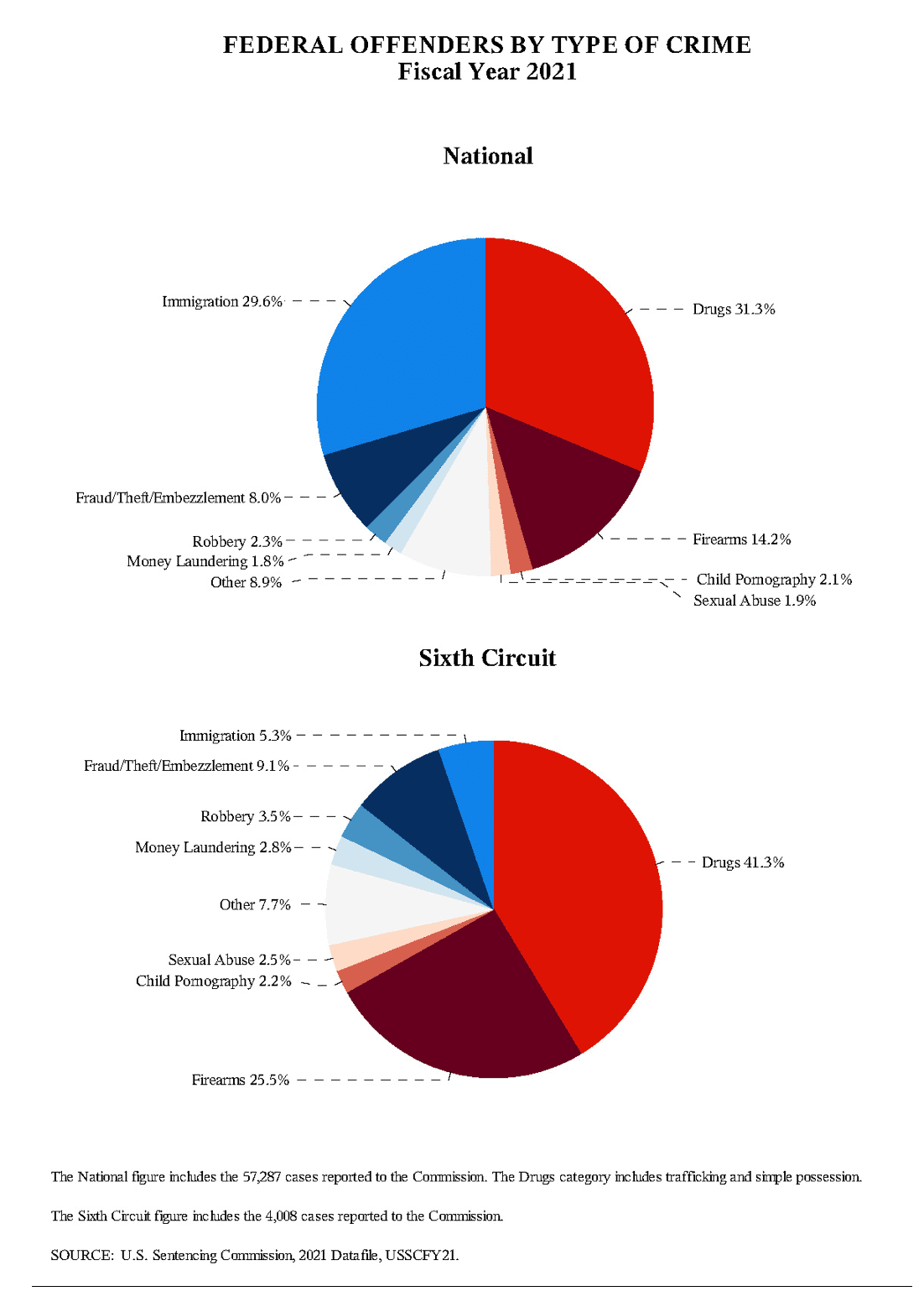
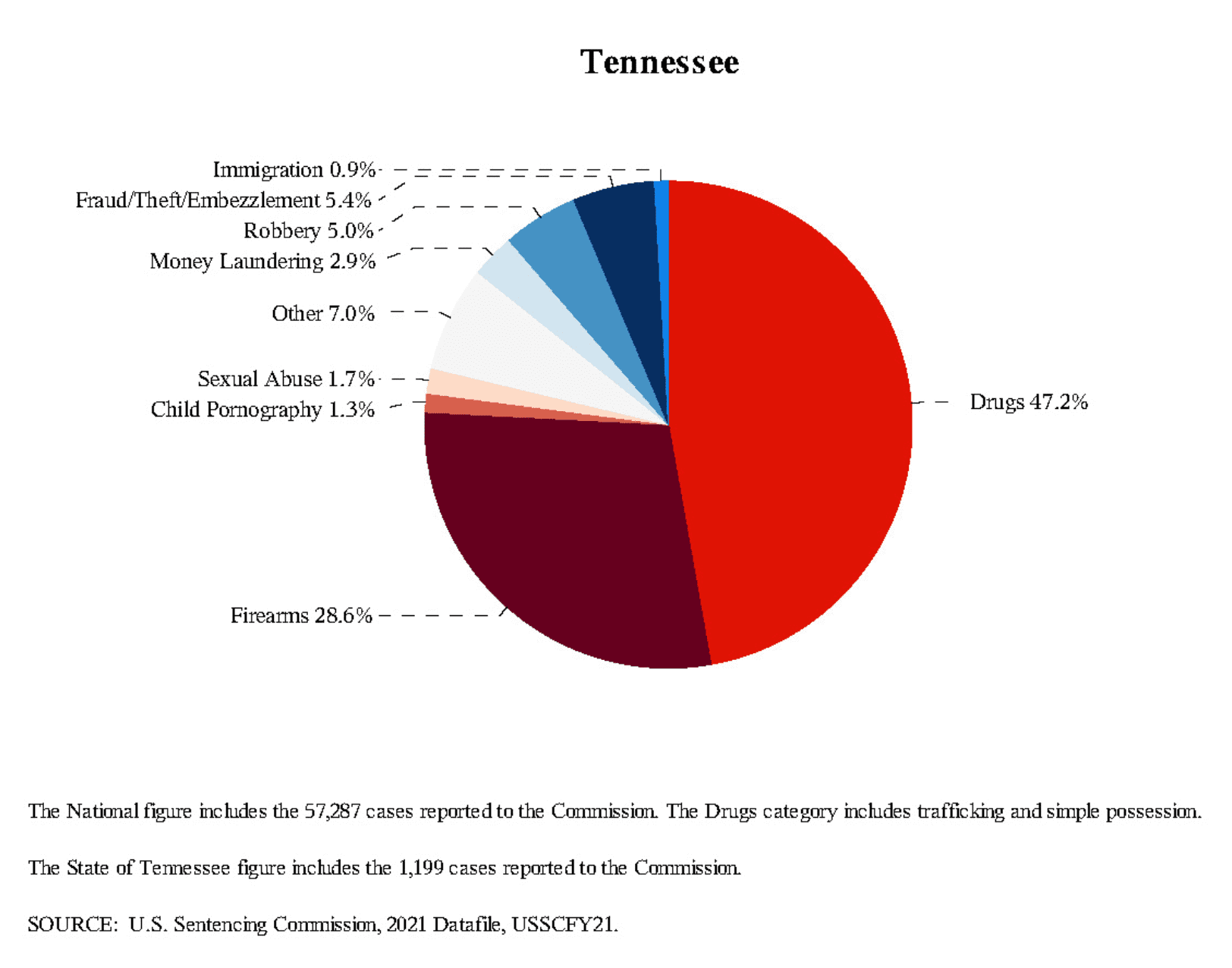
Federal Offenders by Type of crime

tennessee commisssion report.

In the United States in 2021, fraud/theft/embezzlement cases amounted to 4,571 or 8% of federal crimes charged. In the Sixth Circuit, that figure is over 9%, with 365 cases that year.(10) In Tennessee, that is 65 or 5.4% of cases(11).

The large majority of these cases result in guilty pleas. As for the resolution of these cases in 2021, nationally 4,469 (or 97.8%) of these cases resulted in a plea of guilty, with 102 (2.2%) being tried. In the Sixth Circuit, 360 (or 98.6%) of these cases resulted in a plea of guilty, with 5 (1.4%) (12)being tried. In Tennessee, 64 (or 98.6%) resulted in a plea of guilty, with 1 (or 1.4%) being tried. (13)

Sentencing

A single act of wire fraud is punishable for up to 20 years in prison, a fine, or both. In certain situations, this felony is punishable for up to 30 years in prison, a fine, or both. Sentencing in wire fraud cases is highly dependent upon the facts of the case and the character and history of the accused.

As for sentencing data, nationally, individuals convicted of fraud/theft/embezzlement are given an average of 20 months. In the Sixth Circuit, individuals convicted of fraud/theft/embezzlement are sentenced to an average of 15 months.(14) In Tennessee, the average sentence is 21 months.(15)

The district courts arrive at these sentences by using the Federal Sentencing Guidelines. These guidelines are an advisory set of recommendations aimed at ensuring uniform sentencing. They provide a method for arriving at a range of months (called a “guideline range”) and then offer some recommendations for departing from this range in certain situations (increasing or decreasing the sentence). Most wire fraud charges fall under Federal Sentencing Guideline § 2B1.1. Generally, factors that can impact a defendant’s sentence under the wire fraud statute include (but are not limited to) the loss amount, the number of victims, any infliction of emotional harm, the defendant’s criminal history, any substantial assistance to authorities, and more.

As related to the guideline ranges, nationally, individuals convicted of fraud/theft/embezzlement are sentencing within the guideline range 42.9% of the time.

In the Sixth Circuit, individuals convicted of fraud/theft/embezzlement are sentenced within the guideline range 39.7% of the time.(16) In Tennessee, individuals are sentenced within the guidelines range 37.5% of the time. (17)Accordingly, the data shows that district judges are willing to issue sentences outside of the guideline ranges if presented with effective arguments at sentencing.

Conclusion

With decades of experience litigating “white collar” crimes and defending individuals charged with fraud, the legal team at Davis & Hoss is ready to help individuals facing potential allegations of wire fraud or those that simply have questions. Contact Attorney Lee Davis at lee@davis-hoss.com or by phone at 423-266-0605 for more information.


Reference:

  1. 18 U.S.C. § 1343
  2. United States v. Rogers, 769 F.3d 372, 377 (6th Cir. 2014).
  3. Kelly v. United States, 140 S. Ct. 1565, 1573 (2020).
  4. United States v. Montgomery, No. 20-5891, 2022 WL 2284387, at *9 (6th Cir. June 23, 2022) (citations, internal quotations, and punctuation omitted).
  5. Id. (citations, internal quotations, and punctuation omitted).
  6. Id.
  7. United States v. Palma, 58 F.4th 246, 249 (6th Cir. 2023) (citations, internal quotations and punctuation omitted).
  8. United States v. Henderson, No. 3:22-CR-14-TAV-JEM-1, 2022 WL 17061070, at *7 (E.D. Tenn. Nov. 17, 2022) (motion to dismiss denied).
  9. Id. (citing United States v. Washington, 715 F.3d 975, 980 (6th Cir. 2013)).
  10. United States Sentencing Commission Statistical Information Packet, Fiscal Year 2021, Sixth Circuit, Figure A, p. 1; Table 1 p. 3
    https://www.ussc.gov/sites/default/files/pdf/research-and-publications/federal-sentencing-statistics/state-district-circuit/2021/6c21.pdf
  11. United States Sentencing Commission Statistical Information Packet, Fiscal Year 2021, State of Tennessee, Figure A, p. 1; Table 1, p.3
    https://www.ussc.gov/sites/default/files/pdf/research-and-publications/federal-sentencing-statistics/state-district-circuit/2021/tn21.pdf
  12. United States Sentencing Commission Statistical Information Packet, Fiscal Year 2021, Sixth Circuit, Table 3, p. 7
    https://www.ussc.gov/sites/default/files/pdf/research-and-publications/federal-sentencing-statistics/state-district-circuit/2021/6c21.pdf
  13. United States Sentencing Commission Statistical Information Packet, Fiscal Year 2021, State of Tennessee, Table 3, p.7
    https://www.ussc.gov/sites/default/files/pdf/research-and-publications/federal-sentencing-statistics/state-district-circuit/2021/tn21.pdf
  14. United States Sentencing Commission Statistical Information Packet, Fiscal Year 2021, Sixth Circuit, Table 7, p. 11
    https://www.ussc.gov/sites/default/files/pdf/research-and-publications/federal-sentencing-statistics/state-district-circuit/2021/6c21.pdf
  15. United States Sentencing Commission Statistical Information Packet, Fiscal Year 2021, State of Tennessee, Table 7, p. 11
    https://www.ussc.gov/sites/default/files/pdf/research-and-publications/federal-sentencing-statistics/state-district-circuit/2021/tn21.pdf
  16. United States Sentencing Commission Statistical Information Packet, Fiscal Year 2021, Sixth Circuit, Table 10, p. 16
    https://www.ussc.gov/sites/default/files/pdf/research-and-publications/federal-sentencing-statistics/state-district-circuit/2021/6c21.pdf
  17. United States Sentencing Commission Statistical Information Packet, Fiscal Year 2021, State of Tennessee, Table 10, p. 16
    https://www.ussc.gov/sites/default/files/pdf/research-and-publications/federal-sentencing-statistics/state-district-circuit/2021/tn21.pdf