
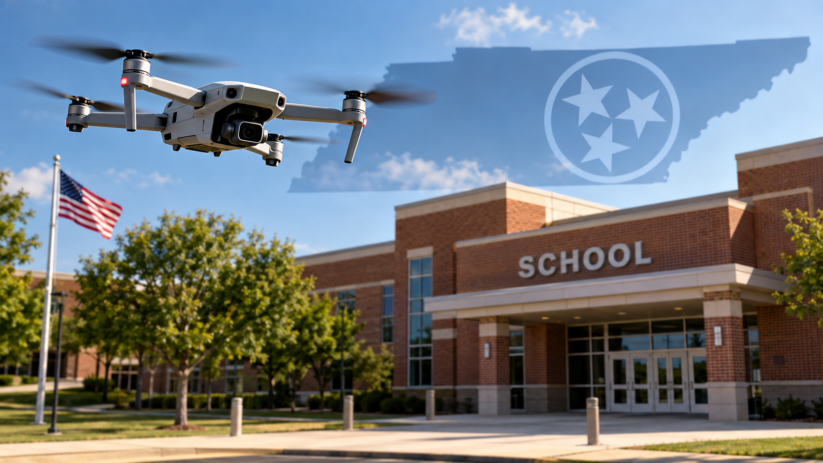
Flying a drone over or near a school in Tennessee does not automatically mean someone has committed a crime. But a new Tennessee law creates criminal penalties for certain drone surveillance over public K-12 school grounds.
Effective July 1, 2026, Tennessee law makes it a Class C misdemeanor to knowingly use an unmanned aircraft over the grounds of a public school serving students in grades K-12 with the intent to conduct surveillance of the school grounds without permission from specified school officials.
That distinction is important. The new law is not a blanket prohibition on every drone that passes over or near a Tennessee school. The location of the drone, the operator’s knowledge and intent, whether permission existed, and whether a statutory exception applies can all matter.
What Changed in Tennessee’s Drone Law in 2026?
Tennessee lawmakers enacted Senate Bill 2434, the companion to House Bill 2147, as Public Chapter 868. The law took effect July 1, 2026.
The proposal changed during the legislative process.
The original legislation broadly addressed knowingly using an unmanned aircraft over school grounds. An amendment narrowed the offense to drone use over the grounds of a public school serving students in grades K-12 when the operator intends to conduct surveillance of the school grounds without permission.
The enacted legislation also contains exceptions involving law enforcement and certain FAA-authorized commercial drone operations.
Those details matter. Someone accused of violating the law should be evaluated under the final enacted requirements rather than a shortened description suggesting that every drone flight over a school is prohibited.
Davis & Hoss represents people facing a range of Tennessee criminal charges, including cases involving newly enacted criminal statutes.
What Does Tennessee’s New School Drone Law Prohibit?
The new law addresses specific conduct rather than every drone flight involving school property.
The offense involves knowingly using an unmanned aircraft:
- over the grounds of a public school serving students in grades K-12;
- with the intent to conduct surveillance of the school grounds; and
- without permission from a school administrator, the director of schools, or the director’s designee.
Each requirement matters when determining whether alleged conduct falls within the new offense.
A drone’s location alone does not establish every element described in the enacted legislation. The law also requires knowing use and an intent to conduct surveillance of the school grounds without the specified permission.
Why Does the Intent to Conduct Surveillance Matter?
The intent requirement is one of the most important limitations in the new law.
The legislation does not say that every person whose drone enters the area over public school grounds commits this offense. It specifically addresses drone use with the intent to conduct surveillance of those grounds.
That makes the circumstances surrounding the flight important.
Depending on the equipment and circumstances, evidence relevant to an investigation could include flight logs, photographs or video, location information, communications concerning the flight, permission records, or FAA-related documentation.
Evidence showing where a drone traveled is not necessarily the same as evidence establishing why the operator used it there.
For example, a drone crossing part of school property during a flight conducted for another purpose raises different factual questions from an aircraft deliberately being used to observe school grounds. Whether the evidence establishes the knowledge and intent required by the statute must be determined from the facts of the individual case.
Which Tennessee Schools Are Covered by the New Law?
The enacted provision does not simply refer to every institution that could be described as a school.
It addresses the grounds of a public school serving students in any of grades kindergarten through twelve.
That limitation matters.
When reviewing an accusation, one question is whether the property involved falls within the category identified by the statute. The analysis should begin with the scope of the enacted provision rather than assuming the same offense applies to every educational property in Tennessee.
Who Can Give Permission for a Drone Operation?
Permission is another important part of the new law.
The legislation specifically refers to permission from:
- a school administrator;
- the director of schools; or
- the director’s designee.
That can become significant when a drone operator was hired or authorized to perform work involving school property.
If permission is disputed, records such as emails, contracts, messages or work orders may help establish whether authorization existed and what activity had been approved.
The statute identifies specific sources of permission, so the facts surrounding who provided the authorization may matter.
Does the New Law Apply to Police Drone Operations?
The provision does not apply to a law enforcement officer acting within the scope of the officer’s lawful duties.
That exception should not be interpreted as resolving every legal question involving police drones.
Government drone surveillance can raise separate statutory and constitutional questions depending on the circumstances. The new school provision addresses a particular criminal offense and should not be treated as a complete statement of Tennessee law concerning police surveillance.
What About Commercial Drone Operators?
The legislature also included an exception addressing certain commercial drone operations.
The provision does not apply to the operator of an unmanned aircraft being used for a commercial purpose if the operator is authorized by the Federal Aviation Administration to conduct operations in that airspace.
The wording is important.
The exception does not simply state that every flight connected with a business is exempt. It specifically addresses a commercial-purpose operation when the operator has the FAA authorization described in the statute.
A commercial operator whose work involves school property should therefore consider the actual circumstances of the flight and the authorization covering operations in that airspace.
What Is the Penalty for Violating Tennessee’s School Drone Law?
A violation of the new school-drone provision is a Class C misdemeanor.
Under Tenn. Code Ann. § 40-35-111(e)(3), a Class C misdemeanor is punishable by up to 30 days of incarceration, a fine of up to $50, or both, unless otherwise provided by statute.
Although a Class C misdemeanor carries less potential punishment than a felony offense, it remains a criminal charge. Davis & Hoss provides additional information about defending these charges through its Tennessee misdemeanor defense services.
A person accused under the new law should not assume that evidence showing a drone over school property establishes the entire offense. The allegations and evidence should be compared with each requirement of the statute.
What Evidence Could Matter in a School Drone Investigation?
Drone technology can create records that may become relevant to determining what happened during a flight.
Depending on the equipment and circumstances, evidence could include flight logs, photographs or video, location information, communications concerning the flight, records showing permission, and documentation concerning a claimed commercial operation or FAA authorization.
Different evidence may address different parts of the allegation.
Flight information could help establish where an aircraft traveled. Images could show what was captured during the operation. Communications could provide information concerning the purpose of the flight. Permission records could help establish whether an authorized school official approved the operation.
None of those examples changes what the statute requires. The relevant question remains whether the evidence supports the elements of the charged offense.
What If a Drone Crossed School Property During Another Flight?
The statute’s knowledge and intent requirements may be important when a drone crosses school property but the operator disputes knowingly using the aircraft over the school grounds with an intent to conduct surveillance.
For example, factual questions could arise when a programmed flight path crosses a property boundary, a drone is being used in connection with neighboring property, or the operator contends that the school grounds were not the intended subject of the operation.
Those circumstances do not automatically establish a defense.
They may, however, be relevant when evaluating whether the evidence proves the knowing use and surveillance intent required by the statute.
Flight records and the circumstances surrounding the operation should therefore be reviewed before conclusions are reached about whether the new offense applies.
Tennessee Criminal Law and Federal Drone Rules Are Separate Issues
Federal aviation requirements regulate unmanned aircraft operations, while Tennessee’s 2026 law creates a state criminal offense directed at specified conduct involving public K-12 school grounds.
Those are separate legal questions.
The Tennessee legislation itself recognizes a connection with federal aviation regulation through its exception for certain commercial-purpose operations authorized by the FAA in the relevant airspace.
Compliance with federal aviation requirements should therefore not automatically be treated as an answer to whether conduct satisfies Tennessee’s criminal statute, except to the extent a statutory exception applies.
This article focuses on the Tennessee criminal offense rather than providing a complete guide to federal drone regulations.
What Should You Do If You Are Accused of Illegal Drone Surveillance at a School?
A school-drone investigation can involve more than establishing that an aircraft appeared over a particular location.
Under the new Tennessee law, questions may include whether the aircraft was knowingly used over covered school grounds, whether there was an intent to conduct surveillance, whether the required permission existed, and whether a statutory exception applies.
Preserving relevant records may be important. Flight logs, original photographs and videos, communications, contracts, permission records and FAA documentation could provide information about what occurred.
Deleting, editing or overwriting potentially relevant information can make it more difficult to establish what happened. Preserving the original records allows the evidence to be evaluated in its existing form.
A criminal defense attorney can compare the allegations and available evidence with the elements Tennessee law requires.
For people facing criminal charges in Chattanooga and surrounding communities, Davis & Hoss provides information about representation through its Hamilton County criminal defense practice.
How a case is handled can depend on the specific charge and local court procedures.
Frequently Asked Questions About Tennessee’s School Drone Law
Is it illegal to fly a drone over a school in Tennessee?
Not every drone flight over or near a school violates the new offense. The 2026 provision addresses knowing use of an unmanned aircraft over the grounds of a public K-12 school with the intent to conduct surveillance of the school grounds without the permission specified by the law.
When did Tennessee’s new school drone law take effect?
Public Chapter 868 took effect July 1, 2026.
Is flying a drone over a Tennessee school a felony?
The offense created by Public Chapter 868 is a Class C misdemeanor, not a felony.
What is the maximum penalty?
Under Tennessee’s misdemeanor sentencing statute, a Class C misdemeanor is punishable by up to 30 days of incarceration, a fine of up to $50, or both, unless otherwise provided by statute.
Does the law apply to every school in Tennessee?
The provision at issue addresses the grounds of a public school serving students in any of grades kindergarten through twelve. It is not a blanket criminal prohibition covering every educational institution in Tennessee.
Does the prosecution have to establish an intent to conduct surveillance?
The enacted legislation includes intent to conduct surveillance of the school grounds as part of the conduct covered by the offense.
Who can give permission for the drone operation?
The legislation refers to permission from a school administrator, the director of schools, or the director’s designee.
Does the law apply to law enforcement?
The provision does not apply to a law enforcement officer acting within the scope of the officer’s lawful duties.
Are commercial drone operators exempt?
The legislation contains an exception for the operator of an unmanned aircraft being used for a commercial purpose if the operator is authorized by the Federal Aviation Administration to conduct operations in that airspace.