
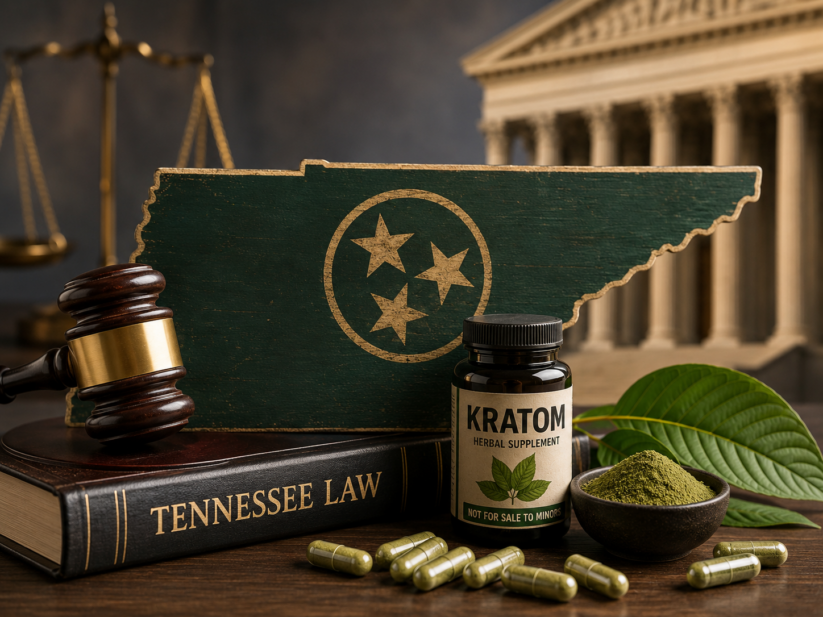
Yes. Kratom is illegal to knowingly possess in Tennessee as of July 1, 2026. Matthew Davenport’s Law changed Tennessee law by making knowing possession of kratom a Class A misdemeanor and creating felony offenses for knowingly manufacturing, delivering, selling, or possessing kratom with the intent to manufacture, deliver, or sell it.
The change is significant because Tennessee did not previously impose the current across-the-board prohibition on adult possession of qualifying natural-form kratom. State law did, however, restrict kratom sales, possession by people under 21, and certain synthetic forms.
The charge can also change significantly depending on the conduct alleged. Simple knowing possession is a misdemeanor. Manufacturing, delivery, sale, and possession with intent are felonies. Certain offenses involving delivery or sale to a minor carry an enhanced felony classification.
An accusation does not establish guilt. The State still has to prove the elements of the charged offense beyond a reasonable doubt. Davis & Hoss represents people facing Tennessee drug crime charges, including cases involving disputed possession, intent, substance identification, and searches by law enforcement.
Is Kratom Illegal in Tennessee Right Now?
Yes. Tennessee’s new kratom prohibition took effect on July 1, 2026.
The Tennessee General Assembly enacted HB 1649/SB 1656, known as Matthew Davenport’s Law. The legislation became Public Chapter 950 and was signed by Governor Bill Lee on May 7, 2026.
The law makes it an offense to knowingly:
- Possess kratom;
- Manufacture, deliver, or sell kratom; or
- Possess kratom with the intent to manufacture, deliver, or sell it.
The distinction matters because knowing possession is classified as a misdemeanor, while the manufacture, delivery, sale, and possession-with-intent offenses carry felony classifications.
Tennessee Kratom Penalties in 2026
Matthew Davenport’s Law establishes the following criminal classifications:
| Alleged Conduct | Criminal Classification |
| Knowingly possessing kratom | Class A misdemeanor |
| Knowingly manufacturing kratom | Class C felony |
| Knowingly delivering kratom | Class C felony |
| Knowingly selling kratom | Class C felony |
| Knowingly possessing kratom with intent to manufacture, deliver, or sell | Class C felony |
| Qualifying offense involving delivery or sale to a minor | Class B felony |
These are the penalties contained in the law that actually took effect July 1, 2026. They should not be confused with the substantially harsher penalties contained in a different kratom proposal introduced during the same legislative session.
What Changed Under Tennessee’s 2026 Kratom Ban?
Before July 1, 2026, Tenn. Code Ann. § 39-17-452 contained kratom-specific restrictions that prohibited knowingly:
- Selling or offering kratom for sale unless it was labeled and in its natural form;
- Distributing, selling, or offering kratom for sale to a person under 21; and
- Purchasing or possessing kratom if the person was under 21.
The statute defined “natural form” as dried, cut, and sifted kratom leaf or raw kratom leaf powder. Tennessee law also addressed specified synthetic forms of mitragynine and hydroxymitragynine.
Matthew Davenport’s Law deleted the prior kratom-specific age and natural-form subdivision and added a new criminal provision in Title 39, Chapter 17, Part 4.
Under the new law, being 21 or older does not provide an exception for personal possession. The new statute makes knowing possession of kratom itself a criminal offense when the substance falls within the law’s definition.
What Is the Penalty for Possessing Kratom in Tennessee?
Knowingly possessing kratom is a Class A misdemeanor.
Under Tennessee’s sentencing statute, a Class A misdemeanor can carry:
- Up to 11 months and 29 days of incarceration;
- A fine of up to $2,500; or
- Both incarceration and a fine.
Matthew Davenport’s Law specifically requires knowing possession. Tennessee law defines a person as acting knowingly with respect to conduct or surrounding circumstances when the person is aware of the nature of the conduct or that the circumstances exist.
The evidence used to establish that required mental state depends on the facts of the case.
Manufacturing, Delivering, or Selling Kratom Is a Class C Felony
Matthew Davenport’s Law creates more serious offenses for conduct connected to manufacture or distribution.
It is a Class C felony to knowingly:
- Manufacture kratom;
- Deliver kratom;
- Sell kratom; or
- Possess kratom with the intent to manufacture, deliver, or sell it.
Tennessee law authorizes a class-wide imprisonment range of three to 15 years for a Class C felony and a potential fine of up to $10,000.
That does not mean every person convicted of a Class C felony receives a sentence anywhere within the entire three-to-15-year range without further analysis. The sentence applicable to an individual defendant is governed by Tennessee sentencing law, including the person’s applicable offender classification.
For someone accused of possessing kratom, the distinction between personal possession and possession with intent to manufacture, deliver, or sell can therefore change the allegation from a misdemeanor to a felony.
When Can a Kratom Offense Become a Class B Felony?
Matthew Davenport’s Law provides a heightened classification when specified conditions involving a minor are present.
A violation of the felony provisions becomes a Class B felony if the violation involved the delivery or sale of kratom to a minor from an adult who:
- Is at least two years older than the minor; and
- Knows that the person is a minor.
Tennessee law authorizes a class-wide imprisonment range of eight to 30 years for a Class B felony and a potential fine of up to $25,000. The sentence applicable to a particular defendant depends on Tennessee sentencing law and the facts relevant to sentencing.
The enhancement should not be reduced to the statement that any kratom offense “involving a minor” is automatically a Class B felony. The statute contains the specific delivery-or-sale, age-difference, and knowledge requirements described above.
What Does Matthew Davenport’s Law Define as Kratom?
The new law uses a broad statutory definition.
It defines kratom to include:
- Any part of the Mitragyna speciosa plant containing the alkaloid mitragynine or metabolite 7-hydroxymitragynine;
- A substance or compound obtained by extraction of the Mitragyna speciosa leaf;
- An alkaloid or alkaloid derivative created through specified chemical synthesis or biosynthetic means that synthetically alters a kratom alkaloid or derivative;
- A derivative, analog, or other preparation of kratom; and
- A derivative, analog, or preparation that is substantially chemically equivalent or identical to kratom.
The prohibition therefore is not limited to dried leaves or raw powder.
Powders, capsules, extracts, liquids, concentrates, or other products may fall within the statute when their contents satisfy its definition. Whether a particular seized product actually meets that statutory definition is a factual and evidentiary question.
What About 7-OH or 7-Hydroxymitragynine?
Matthew Davenport’s Law expressly refers to 7-hydroxymitragynine in its definition of kratom.
That can matter for products marketed as 7-OH, extracts, concentrates, or other preparations.
A product’s marketing name does not by itself decide whether it falls within the criminal statute. The relevant question is whether the substance involved satisfies Tennessee’s statutory definition of kratom.
What If the Kratom Was Purchased Before July 1, 2026?
Matthew Davenport’s Law took effect on July 1, 2026.
The statute contains no express grandfather provision allowing a person to possess kratom after that date merely because the product was purchased before the new law took effect.
The new offense criminalizes knowing possession beginning on its effective date. It does not make an earlier lawful purchase criminal merely because Tennessee later changed the law.
For that reason, the date of the alleged possession can matter when determining whether Matthew Davenport’s Law applies.
Why Do Some Websites Say Kratom Is Still Legal in Tennessee?
Anyone researching Tennessee kratom law in 2026 may encounter conflicting information online.
One reason is timing. Information describing Tennessee’s former age and natural-form rules may have been written before the statewide possession prohibition became effective on July 1, 2026.
There is another source of confusion: two separate kratom bills associated with the name Matthew Davenport’s Law appeared during the 2026 legislative session.
HB 1647/SB 1655 proposed much harsher penalties. That proposal would have made knowing possession a Class D felony, the manufacture, delivery, sale, or possession with intent a Class B felony, and certain minor-related conduct a Class A felony. HB 1647 did not become the enacted law.
The legislation that was enacted was HB 1649/SB 1656, Public Chapter 950.
Under the enacted law:
- Knowing possession is a Class A misdemeanor;
- Knowing manufacture, delivery, sale, or possession with intent is a Class C felony; and
- A qualifying violation involving delivery or sale to a minor is a Class B felony.
Distinguishing between an introduced proposal and the law that was actually enacted is essential when researching the 2026 Tennessee kratom penalties.
Does Finding Kratom Automatically Prove Possession?
No.
Tennessee criminal law recognizes both actual and constructive possession. Constructive possession requires evidence that the accused had the power and intention at a given time to exercise dominion and control over the contraband, either directly or through others.
The Tennessee Supreme Court has also made clear that a person’s mere presence in an area where drugs are found is not sufficient, standing alone, to establish constructive possession. Mere association with someone who controls the drugs or the property where the drugs are found is also insufficient by itself.
At the same time, constructive possession is evaluated from the totality of the circumstances and may be established through circumstantial evidence.
These principles can become important when alleged kratom is discovered in:
- A vehicle occupied by several people;
- A shared home;
- A hotel room;
- A backpack or container;
- A package;
- A workplace; or
- Another location accessible to more than one person.
The evidence may include who controlled the location, who had access to the substance, statements, ownership information, and other circumstances connecting a person to the item.
People facing a misdemeanor possession allegation can learn more about the firm’s representation for misdemeanor charges in Tennessee.
Possession Is Different From Possession With Intent to Sell
The difference between these allegations is substantial.
Knowing possession: Class A misdemeanor.
Knowing possession with intent to manufacture, deliver, or sell: Class C felony.
The State therefore has to prove the additional intent required by the felony offense rather than merely establishing possession.
Evidence prosecutors may rely on in an attempt to establish intent can include the amount and packaging of the substance, communications, transaction records, financial evidence, delivery arrangements, statements, or other surrounding circumstances.
No single fact automatically establishes an intent to manufacture, deliver, or sell. The evidence has to be sufficient to prove the elements of the charged offense beyond a reasonable doubt.
What Can Be Examined in a Tennessee Kratom Criminal Case?
A product being labeled or described as “kratom” does not end the legal analysis.
Depending on the facts and the charge, several issues may require examination.
Whether the Substance Falls Within the Statutory Definition
The State must prove that the substance involved is kratom as defined by Matthew Davenport’s Law.
Because the statute contains a detailed definition involving Mitragyna speciosa, mitragynine, 7-hydroxymitragynine, extracts, derivatives, analogs, and other preparations, the identity and composition of the seized substance may become disputed.
Laboratory analysis may be important evidence in a disputed case. However, Tennessee appellate courts addressing other drug prosecutions have not treated chemical laboratory testing as an absolute requirement for proving the identity of a substance in every criminal case. The sufficiency of the evidence depends on the proof presented.
Because Matthew Davenport’s Law is new, courts may also have to address how existing evidentiary principles apply to its particular statutory definition.
Whether the Accused Person Possessed It
When alleged kratom is not found directly on the accused person, questions involving control, access, ownership, knowledge, and the surrounding circumstances may become significant.
Shared access to a location does not automatically establish possession, but it also does not automatically defeat a possession allegation.
Whether the Possession Was Knowing
The new statute expressly requires knowing possession.
The prosecution therefore must establish the culpable mental state required by the offense as well as possession. What evidence is sufficient to establish knowledge depends on the facts presented.
Whether There Is Evidence of Intent to Manufacture, Deliver, or Sell
The felony possession-with-intent offense requires proof beyond the possession itself.
The evidence offered to establish intent should be evaluated separately from the evidence offered to establish possession.
Whether Police Lawfully Obtained the Evidence
Matthew Davenport’s Law does not eliminate constitutional protections governing searches and seizures.
Depending on the circumstances, a defense lawyer may examine:
- The legal basis for a traffic stop;
- The duration and scope of a detention;
- Whether consent to search was valid;
- The legal basis asserted for a vehicle search;
- A search warrant and its supporting affidavit;
- A search incident to arrest; or
- Another asserted basis for obtaining the evidence.
If evidence was obtained in violation of applicable constitutional protections, the defense may seek suppression when supported by the facts and law.
Matthew Davenport’s Law Also Creates Kratom Testing Requirements
The 2026 law contains provisions beyond the new possession and distribution offenses.
If a county medical examiner’s office or regional forensic center conducts an autopsy and the suspected cause of death is a drug overdose, the law requires the county medical examiner to test the decedent for the presence of kratom.
The physician provision is different. If a treating physician orders toxicology testing because of a suspected drug overdose or suspected neonatal abstinence syndrome, the toxicology testing must include testing for the presence of kratom.
The statute does not say that every treating physician must order toxicology testing whenever an overdose is suspected. The kratom requirement applies when toxicology testing is ordered in one of the specified circumstances.
Matthew Davenport’s Law also directs the Tennessee Commissioner of Labor and Workforce Development to promulgate a rule adding kratom to the definition of a “drug” under Tenn. Code Ann. § 50-9-103 for Tennessee’s drug-free workplace provisions.
Frequently Asked Questions About Tennessee Kratom Law
Is kratom legal in Tennessee in 2026?
No. Since July 1, 2026, Matthew Davenport’s Law makes it a criminal offense to knowingly possess kratom as defined by the statute.
Is possessing kratom a felony in Tennessee?
Simple knowing possession is a Class A misdemeanor.
Knowing possession with intent to manufacture, deliver, or sell kratom is a Class C felony.
Can someone be charged for possessing kratom in Tennessee?
Yes. Knowing possession of kratom became a Class A misdemeanor on July 1, 2026. A criminal charge does not establish guilt, and the State must prove the required elements of the offense.
Can you sell kratom in Tennessee?
Matthew Davenport’s Law makes knowingly selling kratom a Class C felony, subject to the Class B enhancement when the specific statutory requirements involving a minor are established.
Is delivering kratom illegal in Tennessee?
Yes. Matthew Davenport’s Law separately prohibits knowingly delivering kratom and knowingly selling kratom.
Whether particular conduct constitutes a delivery under Tennessee law depends on the facts and the law applicable to the charge.
What about 7-OH in Tennessee?
The statutory definition expressly refers to 7-hydroxymitragynine. Whether a particular product marketed as “7-OH” falls within the prohibition depends on whether its contents satisfy the statute’s definition of kratom.
Is natural kratom leaf legal in Tennessee?
The new law is not limited to synthetic kratom. Its definition expressly includes any part of the Mitragyna speciosa plant containing mitragynine or 7-hydroxymitragynine.
What if I bought kratom before the new law took effect?
Matthew Davenport’s Law contains no express exception allowing continued possession after July 1, 2026, merely because the kratom was purchased before that date.
Is kratom a Schedule I controlled substance under Matthew Davenport’s Law?
Public Chapter 950 does not add kratom to Tennessee’s Schedule I.
Instead, Matthew Davenport’s Law creates separate criminal offenses within Title 39, Chapter 17, Part 4 for knowing possession, manufacture, delivery, sale, and possession with intent involving substances that satisfy its definition of kratom.
Facing a Kratom Possession or Distribution Charge in Tennessee?
Matthew Davenport’s Law represents a major change in Tennessee criminal law. Since July 1, 2026, knowing possession can result in a Class A misdemeanor charge, while allegations involving manufacture, delivery, sale, or possession with intent can result in felony prosecution.
The charge on an arrest report does not determine the final outcome. The prosecution must still prove the statutory elements of the alleged offense. Depending on the case, questions involving possession, knowledge, the identity of the substance, alleged intent to distribute, and the legality of a police search may matter.
If you have been arrested or are under investigation for a kratom-related offense, consider speaking with a criminal defense lawyer before making statements about the substance, where it came from, who owned it, or why it was present.
Learn more about Tennessee criminal defense services and representation for people facing state criminal charges.