Pretrial motions play a central role in Hamilton County criminal defense because they allow courts to resolve legal issues before trial begins. In many cases, pretrial litigation determines what evidence may be admitted, what objections must be addressed early, and how the criminal case timeline will unfold on the court’s docket. Tennessee law provides a structured framework for this process through the Tennessee Rules of Criminal Procedure and constitutional protections recognized under state law.
How Pretrial Litigation Fits Into the Criminal Court Docket
Criminal cases in Hamilton County, TN often begin in General Sessions Court and, in felony matters, proceed to Criminal Court following indictment and arraignment. Once discovery has been reviewed, pretrial litigation begins to address legal questions that can be resolved before trial. These motions are typically scheduled on the criminal court docket prior to trial settings.
Hamilton County’s official Criminal Court information lists the Clerk’s Office at 600 Market Street, Room 102, Courts Building, Chattanooga, TN 37402, with phone number 423-209-7500. The General Sessions criminal office is listed at Room 108 in the same building, with phone number 423-209-7600.
Understanding the procedural posture of a case is critical. Issues raised too late may be treated as waived under Tennessee procedural rules. As a result, motion practice is closely tied to the structure of the criminal case timeline.
Tenn. R. Crim. P. 12 and the Structure of Pretrial Litigation
Most pretrial motion practice in Tennessee is governed by Tenn. R. Crim. P. 12, which permits parties to raise defenses and objections that can be decided without a trial of the general issue. The rule also identifies categories that must be raised before trial.
In practice, Rule 12 shapes how courts manage pretrial litigation. Judges resolve legal disputes early, often through written submissions followed by motion hearings. These rulings define what issues remain open for trial and clarify the boundaries of the charging instrument.
Motions Challenging Legal Defects
Some pretrial motions focus on legal defects apparent from the charging instrument or statutory elements. These matters do not involve credibility determinations. Instead, they involve judicial analysis of legal sufficiency and compliance with procedural requirements.
When the court rules on such motions, it refines the scope of the case and may affect how the prosecution proceeds. Even a denial can narrow the contested issues and guide trial preparation.
Suppression Hearings and Admissibility Determinations
A suppression motion seeks exclusion of evidence based on constitutional standards. Tennessee recognizes protections against unreasonable searches and seizures under Tenn. Const. art. I, § 7.
Suppression hearings are evidentiary hearings. Witnesses may testify, and exhibits may be introduced. The court then makes admissibility determinations that define what the jury may consider. These rulings affect the evidentiary framework of the trial but do not determine guilt.
In Hamilton County Criminal Court, suppression matters are typically scheduled before trial settings and are treated as focused hearings within the broader motion hearing procedure.
Discovery Disputes Under Tenn. R. Crim. P. 16
Discovery issues are a frequent driver of pretrial litigation. Tenn. R. Crim. P. 16 governs discovery and inspection in Tennessee criminal cases.
Disputes over disclosure timing, scope, or format may be resolved through motion hearings. Early resolution of discovery questions can clarify the evidentiary landscape and reduce uncertainty before trial is placed on the calendar.
Trial Structure, Severance, and Court Administration
When multiple charges or defendants are joined in a single prosecution, Tennessee procedure provides a framework for severance requests. These motions address fairness and trial organization.
A severance ruling can affect how the criminal court docket is structured, how many trials are scheduled, and how evidence is presented. These administrative and structural considerations are part of broader Hamilton County criminal defense planning.
What to Expect in a Hamilton County, TN Motion Hearing Procedure
Motion hearings are generally limited to defined legal issues. Some hearings involve legal argument only. Others involve testimony and documentary evidence. The court may request written briefs in advance, particularly in more complex matters.
Filings are processed through the Criminal Court Clerk’s Office at 600 Market Street, Room 102. Scheduling depends on docket availability and the procedural stage of the case. The court’s ruling sets the legal boundaries for subsequent trial proceedings.
Why Pretrial Litigation Matters in Hamilton County Criminal Defense
Pretrial litigation defines the legal framework of a case before a jury is empaneled. It clarifies admissibility standards, resolves procedural objections, and shapes how the trial calendar will proceed. In Hamilton County criminal defense cases, effective motion practice aligns constitutional protections, procedural rules, and local court administration into a structured strategy.
What is pretrial litigation in Hamilton County criminal defense?
It refers to legal motions filed before trial to resolve admissibility, procedural, or structural issues under Tenn. R. Crim. P. 12.
How does a motion hearing procedure work?
The court schedules a focused hearing on specific legal issues. Some hearings involve argument only. Others involve testimony and exhibits before the judge issues a ruling.
What rule governs criminal discovery?
Tenn. R. Crim. P. 16 governs discovery and inspection in Tennessee criminal cases.
What constitutional protection applies to suppression issues?
Tenn. Const. art. I, § 7 addresses protections against unreasonable searches and seizures.
Where is Hamilton County Criminal Court located?
600 Market Street, Chattanooga, Tennessee 37402.
What phone number is listed for the Criminal Court Clerk?
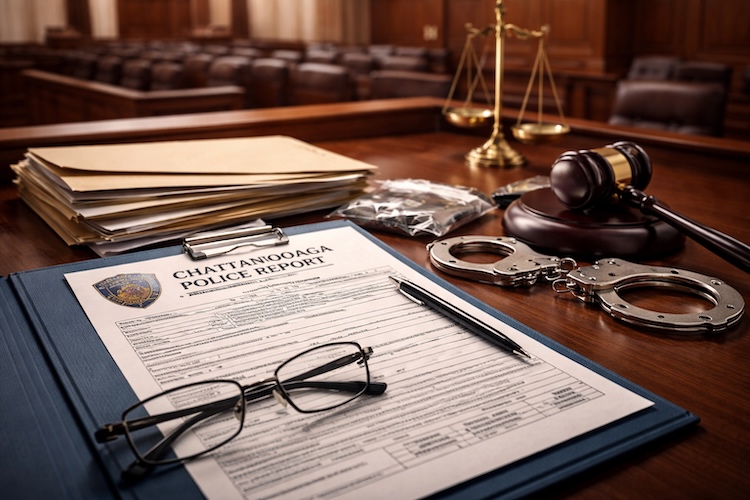
Police reports often play an early role in criminal cases arising in Chattanooga. These documents summarize what officers observed, what witnesses said, and what evidence investigators collected after an incident. When a criminal charge begins, prosecutors, defense attorneys, and judges may review the report to understand the events that led to the arrest or citation.
People charged with offenses frequently review these investigative reports with Chattanooga criminal defense attorneys to better understand how the investigation may affect the court process. Although a police report describes the investigation, Tennessee courts apply strict evidence rules that determine how information from the report may appear during criminal proceedings.
Are Police Reports Evidence in Tennessee Criminal Court
In Tennessee criminal proceedings, a police report usually functions as a written summary of the investigation rather than direct courtroom evidence. Courts typically rely on testimony from officers, physical evidence, and admissible records presented during hearings or trials under the Tennessee Rules of Evidence.
Because the report may contain statements from witnesses or investigators, courts examine these materials under the evidentiary rules that govern out-of-court statements. The general rule against hearsay appears in Tenn. R. Evid. 802, which explains when statements recorded outside the courtroom may be limited during trial testimony.
What Information Is Included in a Chattanooga Police Report
A police report commonly describes the events that led to a criminal investigation. Officers prepare these reports soon after responding to an incident. The document usually includes descriptions of the location, the people involved, and the officer’s observations during the investigation.
The report may also identify potential criminal offenses under Tennessee law and describe the circumstances that led an officer to believe a crime occurred. Officers often document witness statements, physical evidence collected at the scene, and observations made during the investigation.
Although the police report is sometimes referred to as a criminal investigation report, it still represents an officer’s written account of events. Courts evaluate the evidence presented during the case rather than relying solely on the written report.
How Police Reports Support Probable Cause in Tennessee
Police reports frequently contribute to the earliest stage of a criminal case. In Tennessee, an arrest warrant may be issued when a magistrate determines that probable cause exists to believe a criminal offense occurred.
This process often involves a sworn complaint or probable cause affidavit submitted to a judicial officer. Tennessee law describes this procedure in Tenn. R. Crim. P. 3, which governs affidavits of complaint used to initiate criminal charges.
A magistrate may also issue an arrest warrant when probable cause is established under Tenn. R. Crim. P. 4. The information summarized in a law enforcement investigative report may help explain the facts supporting that sworn complaint. Judges review these materials along with other evidence when deciding if a warrant should be issued.
How Prosecutors Review Police Reports During Charging Decisions
Prosecutors often review police reports when evaluating whether a criminal case should move forward. The report may explain the timeline of the investigation, identify potential witnesses, and describe the evidence collected by law enforcement officers.
During the criminal complaint process, prosecutors may compare the police report with other investigative materials to determine how charges should proceed. The report can help clarify what evidence may be available for court proceedings.
Although the report provides important background information, prosecutors must still present admissible evidence during hearings and trials. Tennessee criminal procedure rules govern how that evidence is introduced during the case.
How Defense Attorneys Examine Police Reports
Defense attorneys carefully review police reports when preparing a criminal defense strategy. The report may contain descriptions of the officer’s observations, statements from witnesses, and references to evidence gathered during the investigation.
Attorneys may compare the report with other investigative materials obtained through the criminal discovery process under Tenn. R. Crim. P. 16. These materials may include body camera recordings, dash camera footage, forensic reports, and witness statements.
When inconsistencies appear, attorneys may question officers about the report during cross-examination in court. Individuals seeking more information about the local defense process can review criminal defense representation in Chattanooga to understand how defense lawyers analyze investigative reports.
Can a Police Report Alone Lead to a Criminal Conviction
A police report alone generally does not determine the outcome of a criminal trial in Tennessee. Courts rely primarily on testimony, physical evidence, and admissible records presented during the proceedings.
Officers who wrote the report may testify about what they observed during the investigation. Attorneys may question the officer about the contents of the report during cross-examination in order to clarify how the investigation occurred.
Judges and juries evaluate the reliability of evidence presented during the courtroom proceedings rather than relying solely on a written investigative report.
What Happens If a Police Report Contains Errors
Police reports are often written soon after an incident occurs. Because of the speed involved in documenting events, reports may occasionally contain inaccuracies or incomplete descriptions.
An error in a police report does not automatically determine the outcome of a criminal case. Courts examine testimony, physical evidence, and other investigative materials presented during the proceedings.
Attorneys may question officers about differences between the report and other evidence collected during the investigation. Judges and juries consider the full body of evidence when determining how much weight to give the report.
How Police Reports Are Used During Preliminary Hearings
Some Chattanooga criminal cases begin with hearings in the Hamilton County General Sessions Court. During these early proceedings, judges may review evidence to determine if a felony case should move forward.
Police officers may testify about the events described in their investigative reports during these hearings. Attorneys may ask questions about the investigation, the evidence collected, and the circumstances surrounding the arrest.
If sufficient evidence exists, the case may proceed to the Hamilton County Criminal Court for further proceedings.
Where Chattanooga Criminal Cases Are Heard
Criminal cases arising within Chattanooga city limits are typically prosecuted through the Hamilton County court system. Misdemeanor cases often begin in the Hamilton County General Sessions Court, while felony cases may proceed to the Hamilton County Criminal Court.
These courts operate at the Hamilton County Courthouse located at:
Hamilton County Courthouse
600 Market Street
Chattanooga, Tennessee 37402
Court proceedings follow Tennessee criminal procedure rules and evidence standards. Judges review police reports alongside witness testimony, investigative records, and other admissible evidence presented during the case.
Can a police report be used as evidence in Tennessee criminal court
A police report usually serves as a summary of the investigation rather than direct evidence. Courts often rely on officer testimony and admissible records presented during the proceedings.
Can a police report establish probable cause for an arrest
Information contained in a police report may contribute to the sworn complaint or affidavit presented to a magistrate. Courts review those materials when determining if probable cause exists under Tennessee criminal procedure rules.
Do defense attorneys review police reports in criminal cases
Defense attorneys typically examine police reports during case preparation. They may compare the report with other investigative materials obtained through the criminal discovery process.
What happens if an officer’s testimony differs from the police report
Attorneys may question the officer about differences between the written report and courtroom testimony. Judges and juries evaluate all evidence presented when determining credibility.
Are Chattanooga police reports public records
Some police reports may be available under Tennessee public records laws, although access may be limited during an active investigation.
Where are Chattanooga criminal cases prosecuted
Criminal cases arising in Chattanooga are generally heard in the Hamilton County court system, including General Sessions Court and Criminal Court.
After an arrest in Chattanooga, criminal charges are typically scheduled in courts located in the downtown Chattanooga courthouse complex on Market Street. Early hearings often occur in General Sessions Court (Criminal Division) located inside that courthouse building. More serious criminal matters may later proceed to Criminal Court, where jury trials and additional proceedings occur.
Understanding where criminal cases are heard in Chattanooga can help individuals know where the first court appearance may occur and what stage of the criminal court process may follow an arrest. People facing criminal accusations often begin by speaking with a Chattanooga criminal defense attorney to better understand how the local court system works.
The First Court Appearance After an Arrest in Chattanooga
When someone is arrested, Tennessee law requires that the individual be brought before a magistrate for an initial appearance without unnecessary delay. This early hearing introduces the defendant to the court system and addresses procedural matters that must occur soon after an arrest.
The legal framework for this first appearance is explained in Tennessee Rule of Criminal Procedure 5, which describes the initial appearance before a magistrate and outlines how preliminary hearings may be scheduled in criminal cases.
During this stage, the court reviews procedural matters and determines how the case will move forward through the Chattanooga criminal court process.
Many criminal cases connected to arrests in Chattanooga begin in General Sessions Court (Criminal Division) located in the downtown courthouse complex.
Courts Building
600 Market Street
Chattanooga, Tennessee 37402
This court conducts many early criminal proceedings and may hold hearings required under the Tennessee Rules of Criminal Procedure. In some situations, General Sessions Court conducts preliminary hearings to determine whether a criminal case may proceed to the next stage of prosecution.
The structure and authority of courts across the state are explained by the Tennessee Judicial Branch, which describes how trial courts operate within Tennessee’s judicial system.
When Criminal Cases Move to Criminal Court in Chattanooga
Some criminal cases move beyond early hearings and are later scheduled in Criminal Court located in the Chattanooga courthouse complex. Criminal Court conducts jury trials and other proceedings connected to serious criminal charges.
Formal charging documents used in criminal prosecutions are governed by Tennessee Rule of Criminal Procedure 7, which explains indictments, presentments, and information used in criminal cases.
Criminal Court proceedings occur in courtrooms located within the downtown Chattanooga courthouse complex where many criminal hearings are scheduled.
Individuals looking for more information about defending against criminal accusations in the city may review Chattanooga criminal defense services to better understand how legal counsel assists during criminal proceedings.
Chattanooga City Court and Municipal Cases
Certain matters connected to the city may be scheduled in Chattanooga City Court, which operates separately from the state criminal courts located in the courthouse complex.
Chattanooga City Court
600 Market Street
Room 104
Chattanooga, Tennessee 37402
Phone: (423) 643-7541
City Court typically addresses violations of municipal ordinances and certain city-level citations. Authority for municipal courts in Tennessee is explained by the Tennessee Municipal Court system within the Tennessee Judicial Branch.
Municipal proceedings differ from criminal prosecutions under state law and generally involve matters tied to local city regulations.
Understanding the Chattanooga Criminal Court Process
The Chattanooga criminal court process can involve several stages depending on the charge and how the case progresses through the legal system. Early hearings commonly occur in the downtown courthouse complex, while later proceedings may take place in different courtrooms within that same building.
Procedural rules governing criminal cases across the state appear in the Tennessee Rules of Criminal Procedure, which guide how criminal cases move through Tennessee courts.
People seeking legal guidance about charges arising in the city often review Chattanooga criminal defense representation to better understand the role of defense counsel during criminal proceedings.
FAQs
Where are criminal cases heard in Chattanooga after an arrest?
Most criminal cases connected to arrests in Chattanooga begin in courts located in the downtown Chattanooga courthouse complex on Market Street.
What court handles arrests in Chattanooga, Tennessee?
Early hearings often occur in General Sessions Court (Criminal Division) located in the downtown courthouse complex.
Where do criminal cases go after arrest in Chattanooga?
Criminal cases often begin with early proceedings in General Sessions Court and may later proceed to Criminal Court for additional hearings or trial proceedings.
Which court handles criminal cases in Chattanooga?
Criminal matters tied to arrests in the city are usually heard in courts located in the downtown Chattanooga courthouse complex.
What is the first court appearance after arrest in Chattanooga?
The first appearance is typically an initial appearance before a magistrate, governed by Tennessee Rule of Criminal Procedure 5.
Does Chattanooga City Court hear criminal charges?
Chattanooga City Court generally addresses violations of city ordinances and certain municipal citations.
We use cookies to ensure that we give you the best experience on our website. If you continue to use this site we will assume that you are happy with it.AcceptPrivacy Policy