A criminal case in Chattanooga does not begin in a courtroom. It begins during the earliest stages of an investigation, often before any formal charges are filed. Before a judge reviews a case, prosecutors examine evidence, apply Tennessee legal standards, and determine whether the case should move forward.
Featured Snippet: How Prosecutors Build Criminal Cases
Prosecutors in Chattanooga build criminal cases by reviewing law enforcement investigations, analyzing evidence, and determining whether probable cause exists under Tennessee law. This includes evaluating witness statements, physical evidence, and whether each legal element of an offense can be supported before charges are filed.
How Criminal Cases Begin in Chattanooga
Most criminal cases begin with a law enforcement investigation. This may arise from a traffic stop, a reported incident, or a longer investigation involving multiple agencies.
Officers gather evidence, interview witnesses, and prepare reports documenting their findings. That material is then submitted to a prosecutor for review.
In Hamilton County, misdemeanor cases are generally handled in General Sessions Court, while felony cases may proceed through arrest warrants or the grand jury process.
What Happens Before Charges Are Filed in Tennessee
Before formal charges are filed, prosecutors evaluate whether the available evidence establishes probable cause.
Under Tennessee law, probable cause requires a reasonable basis to believe that a crime occurred and that a specific person committed it. This standard is reflected in Tennessee Rule of Criminal Procedure 4:
https://www.tncourts.gov/rules/rules-criminal-procedure/4
If the available evidence is incomplete or unclear, prosecutors may request additional investigation before proceeding.
How Prosecutors Review Police Reports and Evidence
Prosecutors independently review the materials submitted by law enforcement. They are not required to accept conclusions made by officers.
This review often includes officer reports, witness statements, physical evidence, and digital or video records. If issues appear, prosecutors may delay filing charges until additional facts are developed.
What Prosecutors Look for Before Filing Charges
Charging decisions focus on whether the legal elements of an offense can be supported by the available evidence.
Prosecutors evaluate whether the evidence is consistent, reliable, and lawfully obtained. Issues involving search and seizure are reviewed under the Fourth Amendment to the United States Constitution.
How Evidence Is Evaluated Under Tennessee Law
Evidence must meet relevance and admissibility standards before it can be used in court.
Under Tennessee Rule of Evidence 401, evidence is considered relevant if it makes a fact more or less likely to be true.
Prosecutors evaluate how different types of evidence work together, including physical proof, witness statements, and electronic records.
What Evidence Is Required to File Charges in Tennessee
To initiate charges, prosecutors must have enough evidence to establish probable cause.
This may include police reports, witness accounts, physical evidence, and digital records. The key requirement is that the evidence supports each legal element of the offense.
Probable Cause vs. Proof Beyond a Reasonable Doubt
Probable cause is the standard required to initiate charges. It is lower than the standard required for conviction.
Proof beyond a reasonable doubt applies only at trial. A case may proceed even if the evidence is later challenged or disputed.
The Role of Witness Statements in Criminal Cases
Witness statements are evaluated for consistency, credibility, and how they align with other evidence.
Differences between statements do not necessarily prevent charges, but they may influence how the case is structured and presented.
How Charging Decisions Are Made
After reviewing the evidence, prosecutors determine how to proceed under Tennessee law.
Misdemeanor charges may begin with citations or warrants. Felony charges may proceed through arrest warrants or a grand jury indictment.
Prosecutors may choose charges based on how the facts align with Tennessee statutes. The final charges may differ from what was initially suggested during the investigation.
Charges can also be adjusted as additional information becomes available.
How Hamilton County Procedures Affect Charging
Local court procedures affect how cases move through the system, but they do not change the legal standards required to file charges.
In Hamilton County, the General Sessions Court handles the early stages of criminal cases. Felony cases may involve preliminary hearings and grand jury review before proceeding to Criminal Court.
How a Criminal Case Develops Step by Step
A criminal case typically begins with an investigation, followed by prosecutorial review and the filing of charges if probable cause exists.
After charges are filed, the case proceeds through court appearances, hearings, and pretrial stages in accordance with Tennessee law.
What Happens After Charges Are Filed in Chattanooga
Once charges are filed, the case begins in the General Sessions Court.
At this stage, the court addresses initial appearances, bond conditions, and preliminary hearings for felony cases. If probable cause is established, the case may proceed to the grand jury and then to Criminal Court.
Why Early Case Development Matters
The early stages of a criminal case often influence how it progresses.
The quality of evidence, the legality of how it was obtained, and the decisions made during prosecutorial review all affect whether charges are filed and how the case moves forward.
FAQ: How Prosecutors Build Criminal Cases in Chattanooga
What does a prosecutor do in a criminal case in Tennessee?
A prosecutor reviews evidence and determines whether it supports filing charges under Tennessee law.
Do prosecutors investigate crimes in Chattanooga?
Law enforcement conducts investigations. Prosecutors review the evidence and make charging decisions.
What evidence is needed to file charges?
Evidence must establish probable cause and support each element of the alleged offense.
What is probable cause?
Probable cause is a reasonable basis to believe a crime occurred and a person committed it.
Do all cases go to a grand jury?
Felony cases may be presented to a grand jury. Misdemeanor cases typically do not.
What if evidence was obtained unlawfully?
Evidence obtained in violation of constitutional protections may be excluded from court.
Can charges change after they are filed?
Yes, charges may be modified as the case develops and additional information becomes available.
Missing a court date in Chattanooga can lead to immediate legal consequences. In many cases, the court may issue a bench warrant for arrest and may also pursue a separate charge for failure to appear under Tennessee law. How the situation unfolds depends on the type of case, the court involved, and the specific circumstances surrounding the missed appearance.
For a broader understanding of how criminal cases move through the local system, review Chattanooga criminal defense services to see how courts in Hamilton County process cases from start to finish.
Quick Answer: What Happens If You Miss Court in Chattanooga?
When a defendant misses a court date in Chattanooga, the judge may issue a bench warrant for arrest. The court may also address whether a failure-to-appear charge applies. Bond conditions can change, and in some situations, the court may require the defendant to appear before a judge before any release is considered.
What Actually Happens in Court After a Missed Appearance
When a case is called, and the defendant does not appear, the judge may take action based on the record and the circumstances.
In many cases, the court issues a bench warrant the same day. However, the response is not automatic in every situation. Judges may consider factors such as notice, prior appearances, and any information explaining the absence.
Once a warrant is issued, law enforcement has the authority to take the individual into custody. This often occurs during routine encounters such as traffic stops or other law enforcement interactions.
After arrest, the individual is typically brought before the court. At that point, the judge determines how the case will proceed, including whether bond will be reinstated, modified, or denied.
Bench Warrants Under Tennessee Law
A bench warrant is a court order directing law enforcement to bring a defendant before the court after a missed appearance.
Tennessee law authorizes courts to issue arrest warrants, including bench warrants, under Tenn. Code Ann. § 40-7-118.
A bench warrant generally remains active until it is resolved by the court. It does not automatically expire based on time alone.
Failure to Appear Charges in Tennessee
Missing court can result in a separate criminal charge known as failure to appear.
This offense is defined under Tenn. Code Ann. § 39-16-609. The classification of the charge depends on the underlying case. If the original charge is a misdemeanor, failure to appear is typically charged as a misdemeanor. If the underlying charge is a felony, the failure to appear may be charged as a felony.
However, the statute requires proof that the person knowingly failed to appear as directed. This distinction is important and can affect how the charge is evaluated in court.
What Happens to Bond After Missing Court
Bond is often affected when a defendant misses a court date, but the outcome is not identical in every case.
A judge may revoke the existing bond, increase the bond amount, or impose additional conditions. In some situations, the court may require that the defendant appear before a judge before any new bond is set.
An “open court bond” generally means that the bond is not preset and must be determined by a judge after the individual appears in court.
This type of bond is sometimes used in missed court situations, but it is not automatic in every case. Whether an open court bond is required depends on the judge’s decision and the circumstances involved.
How Chattanooga Courts Evaluate Missed Court Situations
Courts in Chattanooga consider several factors when addressing a missed court appearance.
Judges may look at whether the defendant had proper notice of the court date, whether the absence appears intentional, and whether there is a history of missed appearances. The timing of any effort to address the situation can also matter.
Under Tennessee procedure, appearing in court is typically a condition of release. Failing to appear may affect how the court approaches bond and future scheduling decisions.
Where These Cases Are Handled in Chattanooga
Missed court matters are handled within the Hamilton County court system.
Many cases begin in the General Sessions Court, which handles preliminary matters and misdemeanor cases. More serious cases may proceed to the Criminal Court.
When a warrant is executed, individuals are typically processed through the local jail system before returning to court for further proceedings.
How These Situations Often Develop in Practice
In practice, many individuals are not aware that a warrant has been issued until they encounter law enforcement.
After an arrest, the court evaluates the missed appearance and determines the next steps. This may include addressing bond, scheduling future court dates, and resolving any additional charges.
The missed court appearance becomes part of the case history and may influence how the case proceeds.
Why Timing Matters After Missing Court
Acting promptly after a missed court date can affect how the situation is handled.
Delays can increase the likelihood of arrest and may lead to more restrictive bond conditions. Addressing the issue early allows the court to consider the circumstances before additional complications arise.
To understand how missed appearances fit into the broader legal process, review the Chattanooga criminal defense law firm for insight into how local cases move forward.
Frequently Asked Questions About Missing Court in Chattanooga
Can you go to jail for missing a court date in Chattanooga?
Yes. If a bench warrant is issued, law enforcement may arrest the individual, and they may be held in custody until appearing before a judge. Release depends on the court’s decision.
What is a bench warrant in Tennessee?
A bench warrant is a court order issued when a defendant fails to appear as required. It directs law enforcement to take the individual into custody and bring them before the court.
Is failure to appear always charged when someone misses court?
Not always. While failure to appear is a separate offense under Tennessee law, it requires proof that the person knowingly failed to appear. Whether the charge is filed depends on the circumstances.
Can a missed court date be resolved without arrest?
In some situations, it may be possible to address the issue before an arrest occurs, depending on the status of the warrant and the court’s procedures. Outcomes vary based on the specific case.
What happens to the bond after missing court?
The court may revoke, increase, or modify bond conditions. In some cases, a judge must review the situation before setting a new bond.
How long does a bench warrant last in Tennessee?
A bench warrant generally remains active until it is resolved by the court. It does not expire automatically.
Does missing court make the case more serious?
It can affect how the court views the case, particularly in bond decisions and scheduling. It may also result in additional charges, depending on the circumstances.
Final Takeaway for Chattanooga Defendants
Missing a court date in Chattanooga can lead to a bench warrant, possible arrest, and additional legal consequences under Tennessee law. The exact outcome depends on the facts of the case, the court’s discretion, and how quickly the situation is addressed.
In Tennessee, open container laws do not work the way many people expect. Someone riding in the passenger seat may assume they are outside the reach of alcohol-related traffic laws because they are not driving. Under Tennessee law, that assumption can still create legal problems during a traffic stop.
Tennessee’s statewide open container statute focuses on the driver, not the passenger. Still, a passenger with an open alcoholic beverage can raise red flags during a stop, expose the driver to a citation depending on where the container is located, and create additional issues under local rules that Tennessee law allows cities and counties to adopt.
This article explains how Tennessee’s open container law applies to passengers in vehicles, what officers typically examine during traffic stops, and how drivers and passengers can avoid accidental violations.
Open Container in Tennessee Law Explained
Tennessee’s statewide open container law is found in Tenn. Code Ann. § 55-10-416. This statute makes it unlawful for a driver to possess or consume an open container of an alcoholic beverage while operating a motor vehicle on a public road or highway.
The statute defines an “open container” as any container that has a broken seal or contains alcohol that is immediately capable of being consumed. A bottle that has been opened and recapped, or a can that has already been opened, can still fall within this definition.
The law also explains what it means for a vehicle to be “in operation.” A motor vehicle is treated as being in operation when the engine is running, even if the vehicle is not moving. This matters during traffic stops, roadside pullovers, and situations where a vehicle is idling with the engine on.
Does the Statewide Law Apply to Passengers?
Under the text of § 55-10-416, the offense is written around the driver. The statute does not create a general rule that every person inside a vehicle commits an offense by possessing an open container.
This distinction matters. Tennessee’s statewide statute does not automatically charge passengers simply for holding or consuming alcohol inside a vehicle.
However, the same statute expressly allows cities and counties to adopt their own rules that prohibit passengers from possessing or consuming open containers during vehicle operation. Tennessee law does not restrict the penalties that local governments may attach to those local rules.
As a result, passenger exposure depends on two factors: how the statewide statute applies to the driver and whether a local ordinance applies where the stop occurs.
Why Passengers Still Create Legal Risk During Traffic Stops
Even when a passenger is not directly charged under the statewide statute, an open container inside the vehicle can still create problems.
Driver Possession Under Tennessee Law
The statute explains when an open container may be treated as being in the possession of the driver. That risk increases when the container is not clearly in a passenger’s possession and is not stored in a closed glove compartment, trunk, or other non-passenger area of the vehicle.
In real-world stops, containers found in shared spaces such as cup holders, center consoles, or on the driver-side floorboard may be treated as driver possession. When that happens, the driver may be cited even if a passenger originally brought the alcohol into the vehicle.
Escalation Into DUI Investigation
Visible alcohol inside a vehicle often changes how a traffic stop proceeds. Officers may ask additional questions, watch for impairment indicators, or document alcohol-related observations in their reports.
An open container allegation does not require proof of intoxication. Still, the presence of alcohol can lead to a more detailed investigation beyond the original reason for the stop.
Local Ordinances May Apply
Because Tennessee law permits municipalities and counties to regulate passenger conduct, a passenger may still face consequences under local law. These rules vary by location and operate independently of the statewide driver-focused statute.
What “Possession” Means in Real-World Stops
In everyday language, possession often means ownership. In traffic enforcement, possession focuses on access and control.
A passenger clearly possesses a container when it is in their hand, lap, or personal bag. Problems arise when the container is left in a shared area, shifts during travel, or is not claimed by anyone in the vehicle.
If a container is not clearly associated with a passenger and is accessible to the driver, it may fall within the statute’s framework for driver possession. This is a common reason open container citations arise during stops involving multiple occupants.
Parked Vehicles and “Engine Running” Situations
Many people believe open container laws apply only while driving. Tennessee law does not draw the line that way.
If the engine is running, the vehicle is treated as being in operation under § 55-10-416. This can include situations where a vehicle is stopped on the shoulder, waiting in traffic, or idling near a venue.
A parked vehicle with the engine off generally does not meet the statute’s “in operation” definition. Once the engine is running, the statute becomes relevant again.
Penalties Under Tennessee’s Open Container Statute
A violation of § 55-10-416 is classified as a Class C misdemeanor under Tennessee law and is described in the statute as punishable by fine only.
While the fine itself may appear limited, court costs and administrative fees often accompany misdemeanor traffic offenses. The impact can increase if the open container issue appears alongside DUI-related allegations.
Because outcomes depend on specific facts, no particular result can be assumed in any individual case.
Rideshare Vehicles and Passenger Alcohol
Rideshare passengers often assume open alcohol is allowed because they are not driving. Tennessee law does not provide a blanket exemption for rideshare vehicles.
The statute still applies to a motor vehicle being operated by a driver. If an open container ends up in a shared or driver-accessible area, the same possession analysis applies. Local passenger ordinances may also affect rideshare situations, depending on location.
Not driving does not automatically remove legal risk.
Preventing Open Container Issues
Most open container problems arise from convenience rather than intent. Alcohol is brought into the passenger area and treated like ordinary cargo.
A safer approach under Tennessee law is to keep open alcohol out of the passenger area entirely. If the vehicle has a trunk, that is the most appropriate location. In vehicles without trunks, alcohol should be placed in a non-passenger area as far from the driver as possible.
Passengers should avoid placing open containers in shared spaces, even briefly. Drivers should remember that running the engine can trigger the statute’s operation element.
How Open Container Issues Fit Into DUI Defense Work
Open container allegations often appear in DUI case files as background facts that influenced how a stop unfolded. Even when the open container charge is not the main issue, it may appear in reports used to justify further investigation.
For additional context on how Tennessee’s open container statute affects drivers, see the firm’s resource on open container law in Tennessee.
Soft Next Step
If you were stopped in the Chattanooga area and an open container issue arose, the details matter. Where the container was located, who had access to it, and whether the engine was running all affect how Tennessee law applies. Reviewing those facts carefully is often the most productive place to begin.
FAQs: Tennessee Open Container Law and Passengers
Can a passenger be charged under Tennessee’s statewide open container law?
The statewide statute is written to prohibit driver possession during vehicle operation.
Can cities or counties restrict passengers?
Yes. Tennessee law allows local governments to adopt rules that apply to passengers.
What counts as an open container?
Any container with a broken seal or alcohol ready for consumption.
Does the law apply if the car is not moving?
Yes, if the engine is running.
Can the driver be cited if the passenger brought the alcohol?
Yes, especially if the container is accessible to the driver or located in a shared area.
Are rideshare passengers exempt?
No. The statute still applies to vehicles being operated, and local rules may apply.
Is an open container violation a misdemeanor in Tennessee?
Yes. It is classified as a Class C misdemeanor under state law.
After an arrest, one of the first questions people ask is simple: how long will this take?
In Chattanooga, criminal cases follow a structured legal process under Tennessee law. Some cases move quickly. Others take months or longer, depending on court schedules, legal issues, and how the case develops.
Understanding the timeline can help reduce uncertainty and prepare you for what happens next. If you are dealing with charges, reviewing your situation with a Chattanooga criminal defense lawyer can help you understand where your case stands.
How Long Does a Criminal Case Take in Chattanooga?
Most criminal cases in Chattanooga take several months to resolve. Some cases move faster, while others take longer, depending on the charges, court scheduling, and legal issues involved.
What Happens After an Arrest in Chattanooga?
After an arrest in Tennessee, the person must be brought before a magistrate without unnecessary delay. The court explains the charges, advises rights, and sets conditions for release before the case moves forward.
A criminal case begins with an arrest, either with or without a warrant.
After booking, Tennessee law requires that the individual be taken before a magistrate without unnecessary delay. This requirement is grounded in both the Tennessee Rule of Criminal Procedure 5 and statutory authority.
At this initial appearance:
The charge is explained
Constitutional rights are addressed
Bond or release conditions are considered
This is not a trial. It is a procedural safeguard that begins the case.
Stage 2: Bond and Release Decisions (T.C.A. § 40-11-101)
After the initial appearance, the court determines whether the person remains in custody or is released.
Tennessee law recognizes that individuals are generally eligible for release pending trial, subject to conditions. The court evaluates:
Nature of the alleged offense
Prior history
Risk of failing to appear
Release decisions can directly affect how quickly a case moves forward.
Featured Snippet: What Is a Preliminary Hearing in Tennessee?
A preliminary hearing is a court proceeding where a judge determines whether probable cause exists to believe a crime was committed and the defendant committed it.
Stage 3: Preliminary Hearing or Grand Jury (Rule 5.1)
For felony charges, a defendant has the right to a preliminary hearing unless waived.
Typical timing under Rule 5.1:
In custody: around 14 days
Out of custody: around 30 days
If probable cause is found, the case moves forward. In some situations, the case may proceed directly to a grand jury.
How Felony Cases Move Through Chattanooga Courts
Arrest → Initial appearance → Preliminary hearing → Grand jury → Arraignment → Pretrial → Trial or resolution
This is the standard structure used in Tennessee criminal procedure.
Stage 4: Grand Jury and Indictment
Felony cases proceed to a grand jury for review.
If sufficient evidence exists, the grand jury returns an indictment. This formally charges the defendant in the Criminal Court.
Featured Snippet: What Is an Arraignment in Tennessee?
An arraignment is the stage where a defendant receives formal charges and enters a plea after indictment.
Stage 5: Arraignment (Rule 10)
Under Tennessee Rule of Criminal Procedure 10, arraignment occurs after formal charges.
At this stage:
Charges are presented
The defendant receives the indictment
A plea is entered
This marks the beginning of proceedings in the Criminal Court.
Stage 6: Pretrial Phase (Where Most Time Is Spent)
The pretrial stage is often the longest part of a criminal case.
During this phase:
Evidence is reviewed
Motions may be filed
Hearings are scheduled
The case strategy develops
This is where the case is built and evaluated in detail. Understanding this stage is critical when working with a criminal defense attorney in Chattanooga.
How Long Does a Criminal Case Take in Chattanooga?
A criminal case in Chattanooga may take several months or longer, depending on the charges, court scheduling, and complexity of the case.
Realistic Timeline: What Happens and When
While every case is different, a typical timeline may look like this:
Initial appearance shortly after arrest
Preliminary hearing within weeks (felony cases)
Grand jury review following that stage
Pretrial proceedings lasting several months
Trial scheduling depending on court availability
Delays are common and do not mean something is wrong with the case.
Why Criminal Cases Take Time
Criminal cases take time because courts must review evidence, address legal issues, and schedule hearings. More complex cases or busy court dockets can extend the timeline.
What Can Delay a Criminal Case in Chattanooga?
Featured Snippet: What Causes Delays in Criminal Cases?
Criminal cases may be delayed due to court scheduling, evidence review, legal motions, and case complexity.
Common factors include:
Court docket congestion
Ongoing investigations
Legal motions and hearings
Availability of witnesses
Do All Criminal Cases Take the Same Time?
No. Every case follows its own timeline based on facts, legal issues, and court scheduling.
Some resolve earlier. Others take longer due to complexity.
Stage 7: Resolution or Trial
Not all cases go to trial.
Some are resolved during pretrial proceedings. Others proceed to trial, which requires additional preparation and scheduling.
What Happens Between Court Dates?
Featured Snippet: How Long Between Court Dates in Tennessee?
The time between court dates can range from weeks to months, depending on scheduling and preparation needs.
Between court appearances:
Attorneys review evidence
Legal strategy is developed
Motions may be filed
Continuances are a normal part of the process.
How Chattanooga Courts Handle Criminal Cases
Criminal cases typically move through:
General Sessions Court (misdemeanors and preliminary hearings)
Criminal Court (felony cases after indictment)
You can review full court structure details here:
Chattanooga court system information
Why Accurate Legal Information Matters
Criminal procedure involves multiple stages governed by Tennessee law and court rules. Misunderstanding the process can lead to confusion about timing and expectations.
Reliable, location-specific information helps individuals understand what is happening and what may come next.
Understanding Your Case Timeline
Each stage of a criminal case serves a purpose. Knowing where your case stands can help you make informed decisions moving forward.
To better understand your situation, reviewing your case with a criminal defense attorney in Chattanooga can provide clarity based on the specific facts involved.
FAQ
How long do felony cases take in Chattanooga?
Felony cases often take several months or longer, depending on court scheduling and case complexity.
Do all cases go to trial?
No, some cases resolve earlier, while others proceed through the full court process.
Can a case move faster than expected?
Some cases resolve sooner, but many require time for proper review and preparation.
Why are court dates spaced out?
Court scheduling, legal preparation, and evidence review all affect timing between hearings.
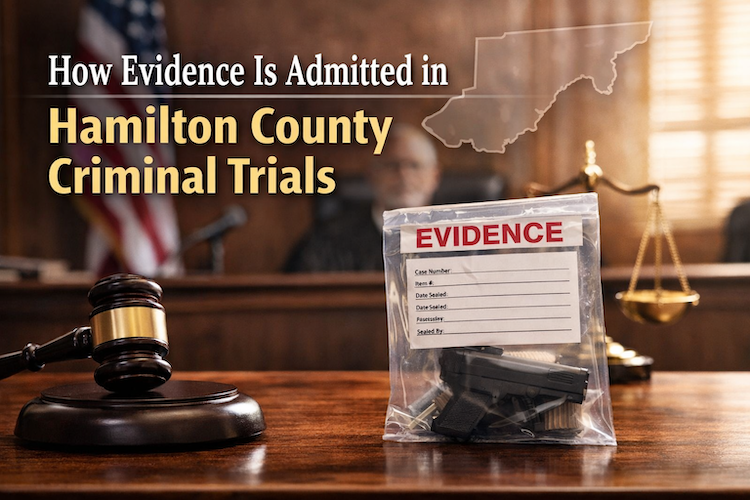
Evidence is admitted in Hamilton County criminal trials through a structured courtroom process governed by the Tennessee Rules of Evidence, the Tennessee Rules of Criminal Procedure, and constitutional protections under Tennessee law. Before jurors may consider any exhibit or testimony, the offering party must lay a proper foundation, respond to objections, and obtain a ruling from the judge.
Felony jury trials in Hamilton County are heard in Hamilton County Criminal Court at 600 Market Street, Chattanooga, Tennessee 37402.
Understanding how evidence is admitted in Hamilton County criminal trials clarifies what jurors are permitted to consider and what may be excluded before deliberations begin.
Governing Law: Tennessee Rules of Evidence
The admissibility of evidence in Tennessee criminal cases is controlled by the Tennessee Rules of Evidence, adopted by the Tennessee Supreme Court.
Relevance is defined under Tennessee Rule of Evidence 401. Evidence is relevant if it has any tendency to make a fact of consequence more or less probable.
Even relevant proof may be excluded under Tennessee Rule of Evidence 403 if its probative value is substantially outweighed by the danger of unfair prejudice or confusion.
Authentication is required under Tennessee Rule of Evidence 901. The offering party must present sufficient proof to support a finding that the exhibit is what it is claimed to be.
Criminal procedure issues are governed by the Tennessee Rules of Criminal Procedure, including Rule 12, which regulates pretrial motions challenging admissibility.
The Hamilton County Criminal Court Evidence Process
The Hamilton County criminal court evidence process follows a consistent sequence during trial.
Marking and Identification of Exhibits
Exhibits are typically pre-marked by the clerk. During testimony, the attorney presents the exhibit to a witness for identification.
A law enforcement officer may identify photographs, physical objects, or digital recordings collected during an investigation. A civilian witness may identify documents or electronic communications based on personal knowledge.
Identification alone does not make the exhibit admissible.
Laying Proper Foundation
Foundation establishes authenticity and relevance. Under Rule 901, the proponent must demonstrate that the exhibit is genuine.
For example, a photograph must be shown to fairly and accurately depict the scene at a relevant time. Digital evidence must be authenticated through testimony explaining how it was obtained and preserved.
Business records may be admitted under Tennessee Rule of Evidence 803(6), provided statutory requirements are satisfied.
If foundation is insufficient, the opposing party may object, and the judge will rule on admissibility.
Midway through the case, evidentiary rulings often influence the overall defense strategy. Readers seeking a broader explanation of trial stages in local courts may review Hamilton County Criminal Defense Law Firm for context regarding felony and misdemeanor proceedings.
Offering the Exhibit and Addressing Objections
After foundation is laid, the attorney formally moves to admit the exhibit into evidence.
Opposing counsel may object on grounds such as hearsay, relevance, lack of authentication, or constitutional violation. Objections are resolved by the judge, sometimes after brief argument outside the presence of the jury.
Only after the court admits the exhibit does it become part of the official trial record.
Chain of Custody in Tennessee Criminal Cases
Chain of custody frequently arises in drug, firearm, and forensic prosecutions. Tennessee law provides that the State must establish a reasonably reliable chain demonstrating the integrity of the evidence from collection through courtroom presentation.
The chain does not require perfection. Minor discrepancies do not automatically require exclusion. Courts evaluate reliability, and any weaknesses may affect the weight assigned by the jury rather than admissibility.
Motions to Suppress Evidence
Evidence may be challenged before trial through a motion to suppress filed under Rule 12 of the Tennessee Rules of Criminal Procedure.
A motion to suppress evidence in Tennessee typically alleges a violation of constitutional protections, including unlawful searches or improper seizures. If the court grants suppression, the excluded evidence cannot be introduced at trial.
Suppression hearings are commonly conducted in Hamilton County Criminal Court before jury selection begins.
Judicial Role and Jury Consideration
Judges determine admissibility. Jurors determine credibility and weight.
After evidence is admitted, jurors evaluate it using pattern jury instructions approved for use in Tennessee courts. The court does not comment on factual strength.
Public information regarding Tennessee court rules is available through the official Tennessee Judicial Branch website. Local scheduling and clerk information are available through Hamilton County’s official court offices.
Frequently Asked Questions
What must occur before evidence is admitted in a Hamilton County criminal trial?
The offering party must demonstrate relevance, lay foundation, address objections, and obtain a judicial ruling under the Tennessee Rules of Evidence.
Can evidence be excluded even if it appears important?
Yes. Tennessee law provides that evidence may be excluded if it violates evidentiary rules or constitutional protections.
What is authentication under Rule 901?
Authentication requires proof sufficient to support a finding that the exhibit is genuine and connected to the case.
Does every objection remove evidence from the trial?
No. An objection triggers judicial review. The court may overrule the objection and admit the evidence.
What happens if a motion to suppress is granted?
If suppression is granted, the excluded evidence cannot be presented to the jury.
Are evidentiary rules different in Hamilton County?
No. The Tennessee Rules of Evidence apply statewide, including Hamilton County Criminal Court.
For additional information regarding criminal proceedings in local courts, readers may visit the firm’s Hamilton County Criminal Defense Attorney page to understand how state-level cases move from arrest through trial under Tennessee law.
We use cookies to ensure that we give you the best experience on our website. If you continue to use this site we will assume that you are happy with it.AcceptPrivacy Policy