
When someone is involved in a fatal crash in Tennessee, the seconds afterward often feel unreal. Shock, fear, and confusion collide at once. Some people stay at the scene. Others leave because they panic, do not understand what happened, or cannot process the severity of the situation.
When the shock settles, a new question appears and does not go away: should I turn myself in?
Turning yourself in after a fatal crash does not erase criminal responsibility. It does not reduce a charge. It does not make the case disappear. Still, voluntary surrender can shape how investigators record your actions and how the early stages of the criminal process unfold. It also affects how judges review risk factors during a bail hearing.
Why People Think About Turning Themselves In After a Fatal Crash
A fatal crash creates emotional overload. People sometimes leave because they were disoriented or did not realize anyone was hurt. Some only learn the seriousness of the event from news updates or contact from law enforcement. Others discover detectives are searching for them and feel overwhelmed.
People start searching for answers because they fear that waiting will look like evasion. They want to know if surrender helps the situation or makes it worse. They worry prosecutors will assume they intended to flee. They feel pressure from uncertainty.
These reactions are common. Turning yourself in does not change the legal elements of the charge, but it can influence how your behavior is interpreted afterward. Surrender also brings structure to a confusing situation.
The Law Behind Vehicular Homicide in Tennessee
Vehicular homicide is defined in Tenn. Code Ann. § 39-13-213.
A person commits vehicular homicide if they cause a death due to:
- Driving under the influence.
- Reckless driving that creates a serious risk of death or serious bodily injury.
- Drag racing.
- Flight from law enforcement.
The penalties depend on which part of the statute applies.
Under Tenn. Code Ann. § 39-13-213:
- Vehicular homicide based on reckless conduct or drag racing is a Class C felony.
- DUI-based vehicular homicide is a Class B felony.
- A death involving a Department of Transportation employee or a highway construction worker in a posted work zone is a Class D felony.
In addition to prison and fines, the court must bar the person from driving or operating a registered vessel in Tennessee for three to ten years after a conviction.
Aggravated vehicular homicide is a separate offense defined in Tenn. Code Ann. § 39-13-218. Tennessee updated this statute in 2025, lowering the alcohol concentration threshold for an aggravated classification from 0.20 percent to 0.15 percent when the case involves qualifying prior convictions.
Understanding these statutes helps explain why surrender influences the early process, not the legal classification of the offense.
What Turning Yourself In Significantly Means in Tennessee
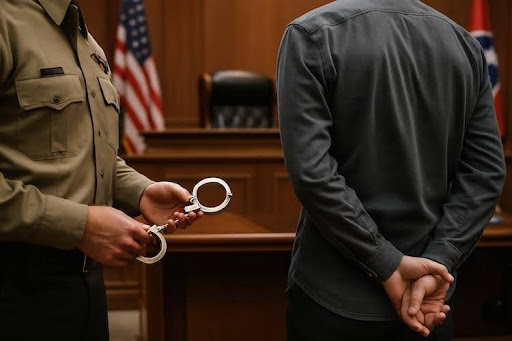
Turning yourself in means voluntarily presenting yourself to law enforcement. It is not the same as confessing. It does not require you to explain what happened at the scene. It does not force you to answer questions.
Surrender can take several forms:
- Walking into a police department to report involvement in the crash.
- Arranging a controlled surrender through legal counsel.
- Meeting detectives at a scheduled time to avoid unnecessary waiting.
Officers document voluntary surrender. That information becomes part of the case file. Judges and prosecutors review these details during early decisions.
Surrender does not require giving a statement. You may provide identification and then wait to speak with legal counsel. This is common and not viewed as uncooperative.
Does Turning Yourself In Help or Hurt the Case
Tennessee law does not give automatic credit for surrender. The charge stays the same. The district attorney still decides charges based on evidence and statute.
Still, surrender affects important parts of the case.
Investigators record that you came in voluntarily.
Prosecutors see that you did not avoid the process.
Judges may view you as lower risk for failing to appear.
A long delay in surrender can create the opposite effect. Investigators may assume evasion. This can affect how the early process unfolds and how prosecutors frame the case during bond arguments.
Surrender does not change the facts of the crash, but it can change how your conduct afterward is interpreted.
How Surrender Influences Bail and Release Conditions
Tennessee judges consider several factors during a bail hearing:
- The seriousness of the charge.
- The person’s criminal history.
- The risk to the community.
- The likelihood of appearing for future hearings.
Voluntary surrender usually weighs in favor of release because it shows you are not trying to avoid the system.
A 2025 change in Tennessee law allows magistrates to rely on reliable hearsay, including computer printouts of state and federal criminal history, when deciding release, as long as the defendant has a fair chance to challenge the information. This means officers’ reports carry more weight at the initial appearance.
If the report states that you voluntarily surrendered, that fact becomes part of the judge’s review. It does not guarantee a lower bond, but it helps provide context.
How Surrender Affects Sentencing in a Vehicular Homicide Case
Tennessee uses structured sentencing ranges based on felony class and prior record. The ranges appear in Tenn. Code Ann. § 40-35-112.
Judges apply mitigating and enhancing factors when selecting a sentence.
There is no automatic sentencing reduction for surrender.
Still, surrender may influence how a judge interprets conduct. Early appearance may be viewed as responsible. Avoiding evasion may support a positive view of character or future risk.
A delay in surrender can have the opposite effect. Prosecutors may argue that the person avoided accountability.
These effects shape the context, not the legal penalty range.
If Alcohol or Drugs Were Involved: What Timing Means
When impairment is suspected, timing matters because alcohol and drug testing is time-sensitive. A delay may prevent officers from obtaining a timely sample.
The case does not collapse without chemical testing. Investigators may use:
- Witness statements.
- Video footage.
- Crash reconstruction.
- Digital evidence.
- Statements from the scene.
If a person surrenders quickly, testing might still be possible. If they surrender after many hours, testing may not help. The timing affects how prosecutors build the case, but surrender does not remove earlier evidence.
What Happens When You Turn Yourself In
People are often scared of the process because they do not know what to expect. In Tennessee, surrender usually follows a clear pattern.
You tell the officer you are turning yourself in.
Officers take you to an intake area for basic information.
Detectives may ask questions, but you may decline until speaking with counsel.
You are booked, fingerprinted, and photographed.
You wait for the initial appearance, where the judge sets bail and explains conditions.
This process is structured, but emotionally heavy. The act of surrender becomes part of the official record.
For additional context, you may review the firm’s page on vehicular homicide cases in Tennessee.
Why Speaking to Investigators Without Legal Advice Creates Problems
Many people want to explain themselves during surrender. They feel guilt or fear and believe their words will help. Police interviews are structured to gather evidence. Statements can be interpreted in ways people do not expect.
Surrender does not require statements. You may provide identification and wait for legal guidance. This prevents accidental statements that complicate the case later.
How Quickly You Should Turn Yourself In
There is no exact rule. Some people come in immediately. Others take time to understand what happened. Others speak with legal counsel first.
Early surrender may be viewed positively. Long delays may raise questions about evasion. The specific facts determine the interpretation.
Avoid actions that create more problems, such as hiding your vehicle, crossing state lines, or making statements that conflict with evidence.
Common Mistakes After a Fatal Crash in Tennessee
Common mistakes include:
- Talking to investigators without legal advice.
- Posting online about the crash.
- Moving or hiding the vehicle.
- Getting advice from friends instead of factual sources.
- Waiting too long to surrender.
- Leaving the county or state without understanding consequences.
These actions can affect how investigators and prosecutors view the person’s conduct.
FAQ
What happens if I turn myself in after the death of another person in a crash
Turning yourself in shows you are not avoiding the legal process. It does not remove homicide charges, but it helps officers document cooperation in cases involving the death of another person.
Can surrender change what people call a vehicular manslaughter or vehicular homicide case
Surrender does not change the charge, but it may affect early decisions in cases people informally call vehicular manslaughter and in formal vehicular homicide or vehicular assault cases. The court still reviews the facts and any prior conviction.
Is self-surrender helpful in a construction zone fatal crash
If the crash happened in a construction zone, penalties may be higher. Turning yourself in does not change that, but it gives the court a clear record of cooperation.
Does surrender matter in cases people see as involuntary manslaughter or aggravated vehicular homicide
Offenses that many think of as involuntary manslaughter, such as reckless homicide or vehicular homicide, and guilty of aggravated vehicular homicide cases all follow Tennessee statutes. Surrender does not change the felony level, but it may help during bond decisions.
Will I face license suspension or long prison time after surrendering
Vehicular homicide convictions include a license suspension of at least three years and up to ten years. Prison ranges depend on the felony class and a person’s prior record, not on surrender.
Can a law firm help during self-surrender for operating a motor vehicle in a fatal crash
A law firm can guide someone through surrender and help prevent accidental statements while discussing operating a motor vehicle during a fatal crash. This support can help avoid common mistakes in United States cases.
Where can I learn more about these legal issues online
Public sites, including Wikipedia the Free Encyclopedia, give general summaries, but they do not replace Tennessee statutes. State laws control how homicide charges are filed in cases involving personal injury or death.