
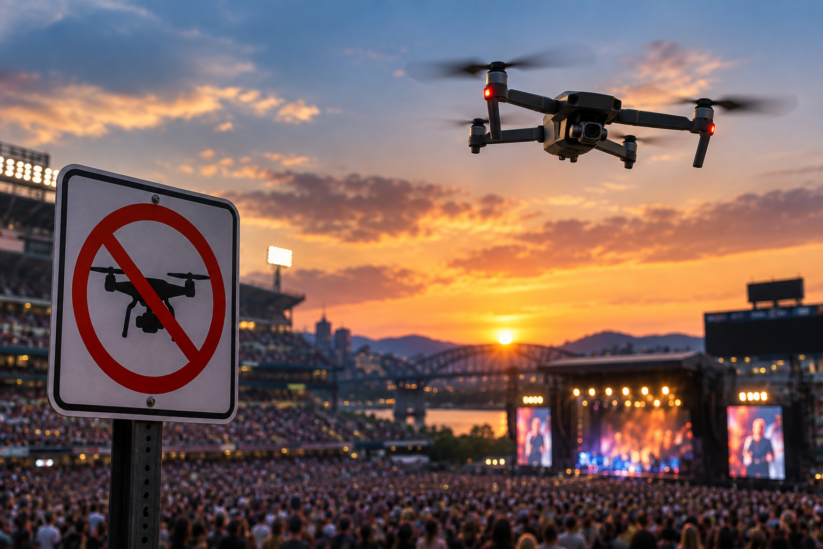
Effective July 1, 2026, Tennessee law makes it a Class A misdemeanor to operate an unmanned aircraft within 400 feet of or above a ticketed entertainment event unless one of the statutory exceptions applies.
The law covers qualifying music, sporting, and performing arts events held at locations with gated entries or barriers that prevent access to the general public and where attendance requires a ticket issued by an owner, operator, or lessee of the property.
The restriction was enacted through Public Chapter 918, originating as House Bill 2368. Tennessee calls the offense “unauthorized operation of an unmanned aircraft.” The law applies to acts occurring on or after July 1, 2026.
The law does not prohibit every drone flight near every concert, sporting event, performance, or public gathering. Whether the offense applies depends on whether the event meets the statutory definition, where the unmanned aircraft was operated, and whether one of the statutory exceptions applies.
Someone accused of violating the law may face questions involving Tennessee criminal law, flight records, event access, authorization, and federal aviation regulations. Davis & Hoss represents people facing criminal allegations through our criminal defense services.
What Does Tennessee’s Ticketed-Event Drone Law Prohibit?
Public Chapter 918 adds a new criminal offense to Tennessee Code Annotated, Title 39, Chapter 13, Part 9.
A person commits the offense of unauthorized operation of an unmanned aircraft by operating an unmanned aircraft within 400 feet of or above a ticketed entertainment event.
A violation is a Class A misdemeanor.
This wording is important because the presence of a drone somewhere near a crowd does not by itself establish this particular offense. The State must prove the elements of the charged offense beyond a reasonable doubt.
Whether one of the statutory exceptions applies may also become an important issue based on the facts of the case.
What Is a “Ticketed Entertainment Event” Under Tennessee Drone Law?
The statute gives “ticketed entertainment event” a specific definition.
It means a music, sporting, or performing arts event held at a location with gated entries or barriers that prevent access to the general public and where attendance requires a ticket issued by an owner, operator, or lessee of the property.
Each part of that definition matters.
An event does not fall within this particular criminal provision solely because music is being performed, a sporting activity is taking place, a large crowd is present, or some type of admission system exists.
The statute requires the event to satisfy its definition of a ticketed entertainment event.
The law also does not state that the required ticket must be purchased. The statutory language focuses on whether a qualifying ticket issued by an owner, operator, or lessee of the property is required for attendance.
Does the Law Apply to Every Concert, Game, or Festival?
No. The event must meet the requirements written into the statute.
A concert, for example, does not fall within this particular offense merely because people have gathered to watch a musical performance. The statute also requires the gated-entry or barrier condition and the specified ticket requirement.
The same analysis applies when the event is described as a game, festival, or performance.
The location alone does not determine whether the statute applies. The question is whether the event meets the statutory requirements, including the type of entertainment involved, the gated-entry or barrier condition, and the ticket requirement.
These details could become important if there is a dispute over whether the event involved in a criminal charge qualifies under the statute.
How Does Tennessee’s 400-Foot Drone Restriction Work?
The central geographic language in the new law prohibits operation of an unmanned aircraft “within four hundred feet (400′) of or above” a qualifying ticketed entertainment event.
That statutory language should be the starting point when evaluating an alleged violation.
The enacted provision establishes the 400-foot restriction but does not separately explain how that distance is to be measured. The statute does not state in this provision that the distance must be measured from a property line, stage, crowd, barrier, or another specific point.
For that reason, the facts and evidence concerning the aircraft’s location may matter when distance is disputed.
The 400-foot language also should not be confused with separate federal aviation rules concerning drone altitude and restricted airspace. Tennessee’s criminal restriction and federal aviation requirements are separate legal issues.
What Is Unauthorized Operation of an Unmanned Aircraft?
“Unauthorized operation of an unmanned aircraft” is the name used by the 2026 legislation for the offense.
The basic prohibited conduct is operating an unmanned aircraft within 400 feet of or above a ticketed entertainment event. The statute then identifies circumstances in which that prohibition does not apply.
The formal name matters because someone researching a citation, arrest, or charging document may encounter “unauthorized operation of an unmanned aircraft” rather than a phrase such as “illegal drone flight.”
A charge should be evaluated according to the elements and exceptions contained in the actual statute rather than assuming that any drone operation near an entertainment venue violates Tennessee law.
What Is the Penalty for Flying a Drone Near a Ticketed Event in Tennessee?
Unauthorized operation of an unmanned aircraft under the new ticketed-event provision is a Class A misdemeanor.
Under Tennessee law, a Class A misdemeanor can carry a sentence of up to 11 months and 29 days and a fine of up to $2,500.
The classification makes this a criminal offense rather than merely a violation of an event’s private drone policy.
Being accused of operating a drone near an event, however, does not establish guilt. The State must prove the elements of the charged offense beyond a reasonable doubt.
Who Is Exempt From Tennessee’s Ticketed-Event Drone Law?
Public Chapter 918 contains eight circumstances in which the prohibition does not apply. They concern an operator who has consent from a person with legal authority over the event; an FAA-authorized operator acting lawfully and consistently with federal regulations; an employee of the property conducting official business; an employee of a regulated utility service provider conducting official business; a law enforcement officer discharging official duties; a member or employee of the U.S. armed forces or Tennessee military forces discharging official duties; an emergency management officer of Tennessee or a Tennessee city, town, municipality, metropolitan government, or county discharging official duties; or a private property owner operating above that property while satisfying the additional requirements in the statute.
Whether one of these exceptions applies depends on the circumstances surrounding the particular operation.
Permission From the Event
The statute contains an exception when the drone operator has obtained consent from a person with legal authority over the ticketed entertainment event.
Whether this exception applies may depend on evidence showing that consent was given and that the person granting the consent had the required authority.
Written communications, agreements, messages, or other available records concerning authorization could become relevant if consent is disputed.
FAA-Authorized Operations
The statute also creates an exception when a person is authorized by the Federal Aviation Administration to operate an unmanned aircraft and is operating the aircraft lawfully and consistently with federal regulations.
The wording of the exception matters. The Tennessee statute expressly incorporates both FAA authorization and lawful operation consistent with federal regulations.
Whether this exception applies should therefore be evaluated based on the operator’s FAA authorization and the circumstances of the particular flight.
Employees Conducting Official Business
The statute separately addresses employees of the property where the ticketed entertainment event is being held when they are conducting official business.
It also addresses employees of water, sewer, electrical, telephone, cable, and other regulated utility service providers when conducting official business.
These provisions should not be expanded beyond their statutory wording. A person’s connection to an event or property does not by itself establish that an exception applies.
Law Enforcement, Military, and Emergency Management
The statute provides exceptions for law enforcement officers engaged in the actual discharge of official duties and members or employees of the U.S. armed forces or Tennessee military forces engaged in the actual discharge of official duties.
It also covers emergency management officers of Tennessee or a Tennessee city, town, municipality, metropolitan government, or county when engaged in the actual discharge of official duties.
Private Property Owners
The law contains a separate exception for an owner of private property operating an unmanned aircraft above that property.
Three additional requirements apply.
The operation must be consistent with federal regulations. It cannot be for the purpose of interfering in any way with the ticketed entertainment event. It also cannot be conducted to surveil or capture images of security procedures for unlawful purposes.
Owning property near an event therefore does not create an unrestricted exemption from the law.
The statutory exception specifically refers to an owner of private property, so it should not automatically be extended to a tenant, guest, employee, or other occupant.
Tennessee Law Is Separate From Federal Drone Restrictions
Tennessee’s ticketed-event drone law does not replace federal aviation restrictions.
Federal law restricts UAS operations at or below 3,000 feet above ground level within a three-nautical-mile radius of stadiums seating 30,000 or more people during certain Major League Baseball games, NFL games, NCAA Division I football games, and major motor speedway events.
Those federal restrictions begin one hour before the scheduled event and continue until one hour after the event concludes.
The federal stadium restriction and Tennessee’s ticketed-event law should not be treated as interchangeable.
Tennessee’s law applies its own definition of a ticketed entertainment event and its own 400-foot restriction. Federal aviation restrictions can cover a much larger area for specified sporting events.
The FAA also uses Temporary Flight Restrictions in other circumstances. Drone operators can check current federal restrictions and NOTAMs through FAA airspace restriction resources.
Charged With Illegal Drone Operation in Tennessee? What Could Matter?
A criminal charge involving a drone near an entertainment event can raise several factual and legal questions.
One issue may be who actually operated the unmanned aircraft. The statute criminalizes operating the aircraft, making the identity of the operator potentially important when disputed.
Another question may be whether the gathering actually satisfied Tennessee’s definition of a ticketed entertainment event.
The aircraft’s location may also matter. If the State alleges that it was within the area covered by the statute, available information concerning the drone’s position could become relevant.
Authorization is another potential issue. If consent was given, the circumstances surrounding that consent and the legal authority of the person who provided it may need to be examined.
Depending on what evidence exists in a particular case, an investigation or defense may involve flight logs, controller information, photographs, video, FAA records, text messages, emails, authorization documents, event information, or witness testimony.
A defense analysis may also require examining whether one of the statutory exceptions applies.
The charge should be compared element by element with the statute and the evidence available in the particular case.
Tennessee Has Other Criminal Laws Involving Drones
The ticketed-event restriction is not Tennessee’s only criminal law concerning unmanned aircraft.
Tennessee law contains other restrictions involving drone operations, and the 2026 legislative session also addressed separate conduct involving unmanned aircraft over certain school property.
Those offenses have different requirements and should not be combined with the ticketed-event offense.
For someone who has received a citation or been arrested, identifying the exact statute alleged in the charging documents can be an important starting point.
What Should You Do After a Tennessee Drone Charge?
Preserving available flight records, photographs, video, communications, authorization documents, and other potentially relevant information can be important when responding to an investigation or criminal charge.
It can also be important to identify the exact statute listed on a citation, warrant, charging document, or other paperwork. Tennessee has multiple laws involving unmanned aircraft, and the particular offense alleged can change the legal analysis.
A lawyer reviewing a ticketed-event drone charge can examine whether the event met the statutory definition, whether the State can establish operation within the area covered by the law, and whether the circumstances implicate one of the statutory exceptions.
For someone facing a criminal charge in Hamilton County, Davis & Hoss provides additional information about representation on our Chattanooga criminal defense attorney page.
Frequently Asked Questions About Tennessee’s Ticketed-Event Drone Law
Is it illegal to fly a drone near a concert in Tennessee?
It can be. Effective July 1, 2026, Tennessee law makes it a Class A misdemeanor to operate an unmanned aircraft within 400 feet of or above a qualifying ticketed entertainment event unless a statutory exception applies.
A concert must meet Tennessee’s statutory definition of a ticketed entertainment event for this particular offense to apply.
How close can a drone fly to a ticketed event in Tennessee?
The Tennessee statute makes it an offense to operate an unmanned aircraft within 400 feet of or above a qualifying ticketed entertainment event unless an exception applies.
The statute does not separately state in this provision how the 400-foot distance is to be measured. Federal aviation restrictions may also independently affect where an unmanned aircraft can operate.
What counts as a ticketed entertainment event?
For this offense, Tennessee defines a ticketed entertainment event as a music, sporting, or performing arts event held at a location with gated entries or barriers preventing access to the general public where attendance requires a ticket issued by an owner, operator, or lessee of the property.
What is the penalty for violating Tennessee’s ticketed-event drone law?
The offense is a Class A misdemeanor. A Tennessee Class A misdemeanor can carry up to 11 months and 29 days of incarceration and a fine of up to $2,500.
Can I fly a drone over my own property near a concert or sporting event?
The statute contains an exception for an owner of private property operating an unmanned aircraft above that property, but three additional conditions apply.
The operation must be consistent with federal regulations, cannot be for the purpose of interfering in any way with the ticketed entertainment event, and cannot be conducted to surveil or capture images of security procedures for unlawful purposes.