
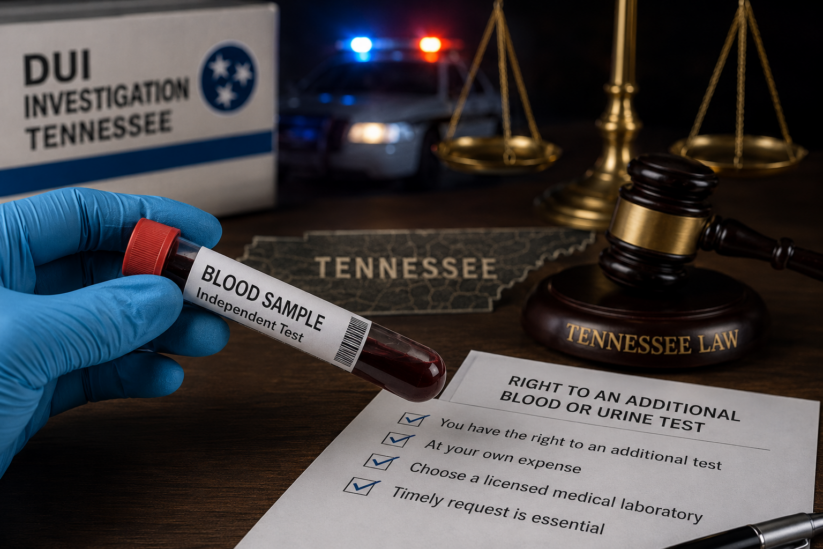
A breath or blood result obtained during a DUI investigation does not always have to be the only chemical-test evidence available. Tennessee law allows a person who undergoes qualifying law-enforcement-requested DUI testing to request an additional blood or urine sample for analysis by a licensed medical laboratory.
This is sometimes described as the right to an independent DUI blood test in Tennessee. The person seeking the additional test must pay for it and must make a genuine effort to arrange it. Law enforcement does not have to pay for the test, administer it, or transport the person to a hospital. Officers cannot, however, improperly prevent a person from making reasonable efforts to obtain a time-sensitive sample.
The right is narrower than it may first appear. It does not apply to every blood sample that later becomes evidence in a DUI prosecution. Tennessee courts distinguish between testing performed under the DUI statutes at law enforcement’s request and blood drawn by hospital personnel solely for medical treatment.
What Does Tennessee’s Additional-Sample Law Provide?
Tennessee Code Annotated § 55-10-408(e) states that a person tested is entitled to have an additional sample of blood or urine procured and tested by a medical laboratory of that person’s choosing. The person requesting the test must pay the expense, and the selected laboratory must be licensed under Title 68, Chapter 29 of the Tennessee Code.
The law refers to an additional sample. It does not give a person the right to replace the test requested by law enforcement with a different test of the person’s choosing.
For example, a person cannot refuse an officer-requested breath test, demand a private blood test instead, and assume that the independent test eliminates any legal issue arising from the refusal. The officer-requested test and the independently procured sample serve different purposes.
Readers seeking a broader explanation of breath, blood, and alcohol-concentration evidence can review how Tennessee BAC testing works. This article addresses only the separate right to seek an additional sample.
When Does the Right to an Independent Test Apply?
The right applies when testing occurs within Tennessee’s statutory framework for law-enforcement-requested DUI testing. This can include a situation in which a person submits to an officer-requested breath test and then asks for an additional blood or urine sample.
In State v. Geselbracht, the defendant completed a breath test and repeatedly requested an independent blood test. The Tennessee Court of Criminal Appeals recognized that the statutory provision allowed an additional blood or urine sample after the breath test. The court also examined the officer’s response to the defendant’s requests.
The statute does not require the State’s first test to be a blood test before a person can seek a separately collected sample. A request following a breath test can fall within the statute.
The right may also arise when blood is drawn by a qualified medical professional at law enforcement’s written request under Tennessee’s DUI-testing laws. The circumstances surrounding the State’s test must be reviewed before deciding that § 55-10-408(e) applies.
Does the Right Apply to Blood Drawn for Medical Treatment?
Not every hospital blood draw triggers the right to an additional test under § 55-10-408(e).
In State v. Amanda L. Moore, hospital personnel drew the defendant’s blood as part of her medical treatment after a serious crash. The blood was not drawn at the request of law enforcement. Police later obtained information about the medical blood test during the criminal investigation.
The Tennessee Court of Criminal Appeals held that the independent-testing provision did not apply because the blood was drawn for medical treatment rather than at law enforcement’s request under the DUI-testing statutes. The later use of the medical test in the prosecution did not convert the hospital draw into law-enforcement-requested testing.
This distinction is important. A person may face a DUI charge involving hospital records without having received a statutory opportunity to request an additional sample at the time of treatment.
Separate questions can arise concerning the legal process used to obtain medical records, the admissibility of the hospital result, and the reliability of the analysis. Those issues are different from the independent-sample right addressed in § 55-10-408(e).
Can You Request a Second Blood Test After a Breath Test?
Yes. Tennessee appellate decisions recognize that a person who completes an officer-requested breath test can seek an additional blood or urine sample for independent analysis.
The requested sample is not a second test administered by police. It is a separately procured sample that the arrested person arranges and pays for through a qualifying laboratory.
A person making the request should communicate that the requested blood or urine sample is additional to the law-enforcement test. This helps distinguish the request from an attempt to refuse or substitute for the test selected by the officer.
A clear statement could be:
“I am requesting an additional blood or urine sample at my expense for testing by a licensed medical laboratory.”
Tennessee law does not prescribe a required script. The central question is if the request was genuine and if the person made reasonable efforts to exercise the right. In Geselbracht, the trial court credited the defendant’s repeated requests and found that the officer’s failure to respond frustrated those efforts. The Court of Criminal Appeals affirmed that fact-specific determination.
Must Police Tell You About the Right?
Tennessee courts have stated that an officer does not have an affirmative duty to advise a person about the independent-testing provision.
An officer’s failure to volunteer information about the right does not, standing alone, establish that the person was denied an independent test. A person who wants the additional sample should make a clear request rather than wait for an officer to explain the process.
The lack of an advisement requirement makes documentation important. A later dispute may center on the words used, the number of requests, the officer’s response, and any attempt to contact a medical provider, family member, lawyer, or laboratory.
Do Police Have to Arrange the Independent Test?
Law enforcement does not have to administer the additional test, locate a laboratory, pay the cost, or take the arrested person to a hospital.
The Court of Criminal Appeals has explained that police have no affirmative duty to transport a person to a hospital for independent testing. The financial responsibility belongs to the person requesting the test. The person must also make a genuine effort to arrange the collection and analysis.
This does not give officers the right to block the request. There is a difference between declining to arrange a private test and preventing the person from making reasonable arrangements.
A request for transportation alone may not require officers to provide a ride. A request for a reasonable opportunity to contact someone who can arrange sample collection raises a different issue. The response must be evaluated in the full circumstances.
What Police Conduct Can Violate the Right?
Tennessee decisions recognize that police may not frustrate reasonable efforts to obtain a separate, time-sensitive sample.
In State v. Livesay, the defendant contacted a physician who was willing to come to the jail and collect a blood sample. A jail officer told the physician that the collection would not be allowed. The Court of Criminal Appeals concluded that the interference deprived the defendant of access to potentially useful evidence and upheld the dismissal of the charges.
In Geselbracht, the defendant repeatedly asked for another test after completing a breath test. The trial court found that the officer ignored the request and acted as though another test was unnecessary. The appellate court affirmed the dismissal after accepting the trial court’s findings that the request was genuine and that the officer frustrated a reasonable effort to obtain evidence.
These cases do not establish that every unanswered request requires dismissal. The result depends on the evidence presented and the court’s findings concerning the request, the officer’s response, the person’s ability to arrange the test, and the loss of the opportunity to collect the sample.
How Quickly Must the Additional Sample Be Collected?
Section 55-10-408(e) does not state a fixed number of minutes or hours for procuring the additional sample. Delay can still matter because the purpose of the test is to obtain evidence that can be compared with the State’s testing and the person’s condition near the relevant time.
A sample collected soon after the law-enforcement test may provide a more useful comparison than one collected much later. The significance of the collection time depends on the facts, the substance being measured, the testing method, and any toxicological interpretation.
The time-sensitive nature of the evidence was central to the concerns discussed in Livesay and Geselbracht. Once the opportunity to collect a meaningful sample has passed, it cannot be recreated through a later draw.
A person who wants an independent chemical test should make the request promptly and repeat it clearly if the first request is not acknowledged.
Who Pays for the Additional Blood or Urine Test?
The person requesting the independent analysis must pay for it. Tennessee law does not require the police department, jail, county, or State to cover the cost.
The expense may include the collection procedure, medical-provider services, laboratory analysis, specimen handling, documentation, and testimony needed to present or explain the result in court.
The laboratory must be licensed under Tennessee’s medical-laboratory laws. The statutory language does not permit testing through an unlicensed person or an informal testing service.
Financial responsibility does not permit law enforcement to interfere with a genuine effort by a person who is prepared to arrange and pay for the additional sample.
Is a New Sample the Same as Retesting the State’s Blood?
No. Procuring an additional sample under § 55-10-408(e) is different from asking another laboratory to reanalyze blood already collected by the State.
The statutory right concerns a new sample of blood or urine collected separately for independent analysis. Retesting the State’s specimen depends on different issues, including discovery, preservation, the amount of sample remaining, the procedures used by the State laboratory, and any order governing access to the evidence.
A State laboratory may consume some or all of a specimen during testing. Tennessee courts evaluate preservation claims by considering the possible evidentiary value of the material, the availability of comparable evidence, and the circumstances surrounding the loss or consumption of the specimen. A defendant is not automatically entitled to assume that a testable portion will remain.
A lawyer reviewing a DUI blood case should determine if a separate sample was requested, if any part of the State’s specimen remains, and if laboratory records permit an independent review of the testing process.
Does a Different Independent Result End the DUI Case?
An independent result does not automatically invalidate the State’s test or require dismissal of a DUI charge.
The results may differ because the samples were collected at different times, involved different specimen types, were tested through different procedures, or were interpreted under different laboratory methods. The meaning of any difference may require testimony from a qualified toxicologist or laboratory witness.
The prosecution may also rely on evidence apart from chemical testing, including driving conduct, officer observations, video recordings, statements, or other admissible proof.
The independent result may support a defense argument, raise questions about the State’s analysis, or have limited comparative value. Its significance must be considered with the collection records, laboratory documentation, timing, and remaining evidence.
Broader issues involving the State’s proof are discussed in the firm’s resource on challenging DUI evidence.
What Should You Do If Police Denied the Request?
Tell your attorney exactly what happened as soon as possible. The details can determine if the incident involved a failure to arrange a test, a misunderstanding, or improper interference with a reasonable effort.
Important facts can include the words used to request the test, when the request was made, how many times it was repeated, who heard it, and how each officer responded. Attempts to call a lawyer, physician, laboratory, family member, or other person should also be documented.
Body-camera recordings, patrol-car video, jail surveillance, booking records, recorded jail calls, dispatch communications, text messages, medical records, and witness testimony may show that the request was made or that arrangements were underway.
A lawyer can seek preservation of relevant recordings and records before they are deleted under routine retention policies. The lawyer can then evaluate if the police response violated the statute, due process, or another protection applicable to the case.
Dismissal is not automatic. Livesay and Geselbracht show that dismissal can be an available remedy when police interference causes the loss of time-sensitive evidence, but the result rests on the proof and findings in the individual case.
Frequently Asked Questions
Can the additional independent sample be urine rather than blood?
Yes. Section 55-10-408(e) refers to an additional sample of blood or urine. The additional sample does not replace the test requested by law enforcement.
Can I choose the laboratory?
The statute allows the person tested to select the medical laboratory. The laboratory must be licensed under Title 68, Chapter 29, and the person requesting the analysis must pay the expense.
Do officers have to drive me to the laboratory?
Tennessee appellate decisions do not impose a duty requiring officers to transport an arrested person to a hospital or laboratory for private testing. Officers cannot improperly prevent reasonable efforts to arrange a timely sample.
Does the right apply if the hospital drew blood to treat my injuries?
Not solely because the hospital result later becomes part of the DUI investigation. In State v. Moore, the Court of Criminal Appeals held that § 55-10-408(e) did not apply to blood drawn in the ordinary course of medical treatment rather than at law enforcement’s request.
Can police get a warrant after I request an independent test?
A request for an additional sample does not prevent law enforcement from seeking a warrant or relying on other lawful authority to obtain evidence. The validity of a warrant, the State’s collection process, and the independent-test request must be evaluated as separate issues.
Is the case dismissed if my request was ignored?
Not automatically. A court must examine the facts, including the clarity and sincerity of the request, the efforts made to arrange the test, the officer’s conduct, and the loss of potentially useful evidence. Tennessee appellate courts have affirmed dismissal under the specific circumstances presented in Livesay and Geselbracht.
Speak With Davis & Hoss About an Independent-Test Request
A denied request for an additional blood or urine sample can raise issues that are separate from the accuracy of the State’s chemical test. Recordings, booking records, witness accounts, and the sequence of events may show if officers permitted reasonable efforts or improperly prevented the collection of time-sensitive evidence.
Davis & Hoss can review the law-enforcement test, any request for an additional sample, the police response, laboratory documentation, and the other evidence involved in the arrest. Learn more about the firm’s approach to Tennessee DUI defense.
This article is provided for general informational purposes. It is not legal advice and does not create an attorney-client relationship.