
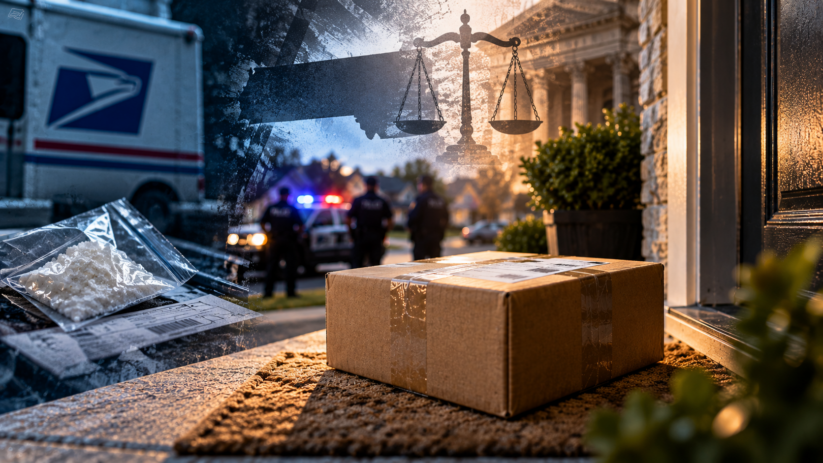
If law enforcement finds drugs in a package addressed to your Tennessee home, the address on the package can be evidence in an investigation. But the prosecution must still prove the elements of the criminal offense charged, including the required mental state.
That distinction can be important in a mailed-package case. Investigators may attempt to determine who arranged for the shipment, who knew what it contained, and who exercised control over it.
Law enforcement may also use a controlled delivery after identifying drugs in a package. The U.S. Postal Inspection Service recognizes controlled deliveries and surveillance as investigative techniques used in narcotics investigations.
A mailed-drug investigation may implicate Tennessee law, federal law, or both, depending on the alleged conduct and the evidence.
A Package Addressed to Your Home Is Evidence, but Knowledge Still Matters
Under Tennessee law, drug offenses can depend on what a person knowingly possessed or intended to do with a controlled substance.
Tennessee Code Annotated § 39-17-418 addresses knowing possession or casual exchange of a controlled substance without lawful authorization. Tennessee Code Annotated § 39-17-417 addresses more serious conduct, including knowingly manufacturing, delivering, selling, or possessing a controlled substance with intent to manufacture, deliver, or sell it.
This means the fact that a package was delivered to a particular address does not replace the prosecution’s obligation to establish the elements of the offense charged.
Evidence connecting a person to the package may become important in determining whether the State can establish knowing possession or other prohibited conduct.
Someone facing Tennessee drug crime charges involving a mailed package should have the evidence and the specific charge examined carefully.
What Happens When Law Enforcement Intercepts a Package Containing Drugs?
Law enforcement does not have to end an investigation when suspected drugs are discovered in a package.
The U.S. Postal Inspection Service investigates illegal drugs moving through the U.S. Mail and works with federal, state, and local law enforcement agencies in narcotics investigations.
Postal Inspectors may use investigative techniques that include controlled deliveries and surveillance to identify the recipient of a package or people connected to drug trafficking.
That means a package containing suspected drugs may continue toward its destination as part of an investigation rather than being permanently removed from the mail stream as soon as the drugs are identified.
What happens after that point depends on the facts of the investigation.
What Is a Controlled Delivery?
A controlled delivery occurs when law enforcement allows a package containing suspected contraband to continue toward its destination while the delivery is monitored as part of the investigation.
This is a recognized investigative technique.
The U.S. Postal Inspection Service has stated that when sufficient quantities of illegal drugs are found in a mailpiece, Postal Inspectors may use investigative techniques such as controlled deliveries or surveillance to identify a recipient or drug-trafficking network.
A controlled delivery can therefore provide investigators with additional evidence about who is connected to the shipment.
It does not, by itself, eliminate the prosecution’s obligation to prove the elements of any criminal charge that follows.
Does Accepting a Package Mean You Possessed the Drugs?
Possession under Tennessee law can be actual or constructive.
Actual possession involves physical control over an item. Constructive possession does not require the drugs to be physically in someone’s hand or pocket.
Tennessee appellate courts explain that constructive possession requires the accused to have the power and intention to exercise dominion and control over the item. In other words, the issue is whether the evidence establishes the ability and intent to exercise control over the contraband.
This distinction can matter when a package is delivered to a residence occupied by more than one person.
For example, if one resident brings a package inside, that fact may become part of the evidence. The legal question remains whether the evidence establishes the elements of the charged offense, including any required knowledge and possession.
Tennessee appellate authority has also cautioned that mere presence in an area where contraband is discovered, or mere association with someone who possesses contraband, is not enough by itself to establish constructive possession.
For more information about these principles, see our discussion of drug possession charges in Tennessee.
What If You Did Not Know What Was Inside the Package?
Knowledge can become a significant issue when the prosecution alleges possession of drugs found in a mailed package.
A person’s name or address appearing on a package may be part of the evidence, but the prosecution must still establish the mental state required by the charged offense.
This is particularly important when more than one person has access to a residence or delivery location.
The facts surrounding the shipment can therefore matter when determining whether the evidence establishes knowing possession.
Rather than assuming that delivery to an address proves knowledge, a defense investigation can examine the evidence the government relies upon to connect the accused to the package and its contents.
Can a Drug Package Lead to a Possession-with-Intent Charge?
Yes, if the evidence supports the elements of that offense.
Tennessee Code Annotated § 39-17-417 prohibits knowingly possessing a controlled substance with intent to manufacture, deliver, or sell it.
Tennessee law also addresses how intent may be established.
Under Tenn. Code Ann. § 39-17-419, it may be inferred from the amount of a controlled substance possessed, along with other relevant facts surrounding the arrest, that the controlled substance was possessed for the purpose of selling or otherwise dispensing it.
The amount of drugs therefore can matter, but quantity is not the only relevant consideration under the statute.
Tennessee appellate decisions have considered other evidence surrounding alleged possession when determining whether evidence supports an inference of intent to sell or deliver.
Can Police Search Your Home After Finding Drugs in a Package?
Finding suspected drugs in a package does not give law enforcement unrestricted authority to search an entire residence.
The Fourth Amendment protects against unreasonable searches and seizures. When law enforcement obtains a search warrant for a home, the warrant must be supported by probable cause and must particularly describe the place to be searched and the persons or things to be seized.
The search of a package and a later search of a residence can present separate legal questions.
If investigators obtain a search warrant for a residence, a defense attorney can examine whether the warrant was supported by probable cause and whether officers remained within the authorized scope of the search.
If officers conduct a warrantless search, the analysis may involve whether the government can establish that a recognized exception to the warrant requirement applied.
The legality of a search depends on the facts and the legal authority relied upon by law enforcement.
Can Drugs Sent Through the Mail Lead to Federal Charges?
Federal controlled-substance laws may also apply to conduct involving drugs sent through the mail.
Under 21 U.S.C. § 841(a)(1), federal law prohibits knowingly or intentionally manufacturing, distributing, dispensing, or possessing with intent to manufacture, distribute, or dispense a controlled substance, except as authorized by law.
Federal law separately addresses knowing or intentional unauthorized possession of controlled substances under 21 U.S.C. § 844.
Another federal provision can apply to the use of communication facilities in connection with federal drug felonies.
Under 21 U.S.C. § 843(b), it is unlawful to knowingly or intentionally use a communication facility to commit, cause, or facilitate an act constituting a felony under specified federal drug laws. The statute expressly includes mail within its definition of a communication facility.
The use of mail does not automatically establish a violation of § 843(b). Whether the statute applies depends on the facts and the alleged underlying federal drug felony.
Davis & Hoss also represents clients facing federal drug charges.
Tennessee’s Kratom Law Changed in 2026
Tennessee made an important change to its kratom laws in 2026.
Matthew Davenport’s Law, enacted as Public Chapter 950, created criminal offenses and testing requirements related to kratom. The Tennessee General Assembly confirms that the legislation was signed by the governor on May 7, 2026, and became effective July 1, 2026.
The change is relevant to mailed-package investigations because information about Tennessee kratom law published before July 1, 2026 may no longer accurately describe current Tennessee law.
The substance involved in a package therefore matters when determining which criminal statute may apply.
What Should You Do If Law Enforcement Contacts You About a Package?
If law enforcement contacts you about a suspected drug shipment, you have the right to remain silent and the right to seek legal advice.
Speaking with a criminal defense attorney before making a statement allows you to understand the investigation and the possible consequences of answering questions.
The specific charge, the evidence connecting a person to the package, and the legality of any searches can all affect the defense analysis.
Frequently Asked Questions
Can I be charged because drugs were mailed to my address?
The delivery address may be evidence, but the prosecution must prove the elements of the charged offense. For a possession allegation, that includes establishing the possession and mental state required by Tennessee law.
What if the package has my name on it but I did not order it?
A person’s name on a package may be relevant evidence, but it does not replace the prosecution’s obligation to establish the elements of the offense charged. The surrounding evidence becomes important in determining whether the State can establish knowing possession or other prohibited conduct.
What if someone else in my house ordered the drugs?
When several people have access to a residence, constructive-possession principles can become important. Tennessee law looks to whether the accused had the power and intention to exercise dominion and control over the contraband. Mere presence near contraband is not enough by itself to establish constructive possession.
Can law enforcement deliver a package after discovering drugs inside?
Yes. Controlled delivery is a recognized investigative technique. The U.S. Postal Inspection Service identifies controlled deliveries and surveillance as techniques that may be used in narcotics investigations.
Does picking up a drug package prove possession?
Picking up a package may be evidence considered in the investigation, but the prosecution must prove the elements of the charged offense. Tennessee constructive-possession law focuses on whether the evidence establishes the power and intention to exercise dominion and control over the contraband.
Can a mailed drug package become a federal case?
Federal drug statutes may apply when the conduct satisfies the elements of a federal offense. The U.S. Postal Inspection Service investigates illegal drugs moving through the U.S. Mail, and federal law also addresses the use of mail to facilitate specified federal drug felonies.
Facing an Investigation Over Drugs Mailed to Your Home?
A drug package investigation can raise questions about knowledge, actual or constructive possession, intent to sell or deliver, controlled deliveries, searches, and whether state or federal law applies.
The fact that a person’s name or address appears on a package can be evidence, but it does not replace the government’s obligation to prove the elements of the criminal offense charged.
If police, Postal Inspectors, or another law enforcement agency contacts you about a package containing suspected drugs, speaking with a criminal defense attorney before making a statement can help you understand the allegations, the evidence, and the legal issues involved.