
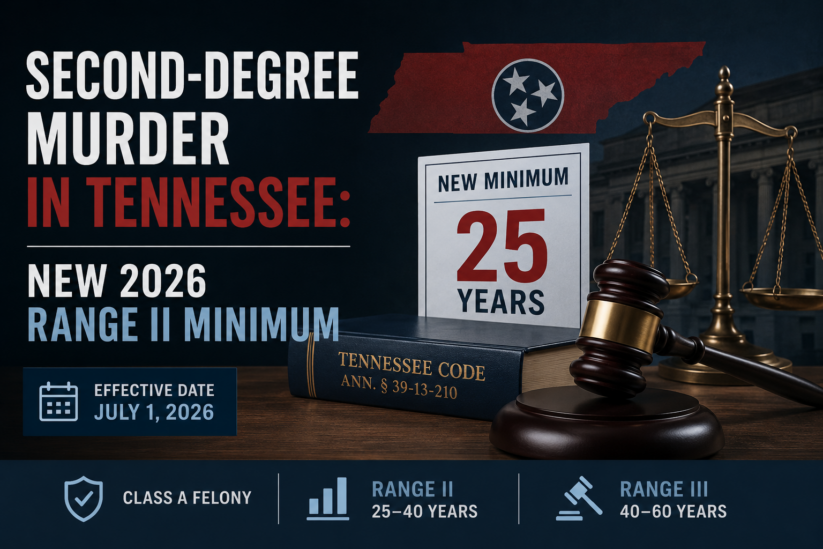
Tennessee changed the sentencing law for one form of second-degree murder on July 1, 2026. Under Public Chapter 752, a person convicted of knowingly killing another under Tenn. Code Ann. § 39-13-210(a)(1) must receive a sentence no lower than Range II.
Because second-degree murder is a Class A felony, Range II carries a sentence of 25 to 40 years. The new law therefore establishes a 25-year sentencing floor for a qualifying knowing killing committed on or after July 1, 2026. A Range III sentence of 40 to 60 years remains available when appropriate.
The amendment does not redefine second-degree murder, and it does not impose the new Range II requirement on every statutory form of second-degree murder. It changes the sentencing floor for the knowing-killing offense identified in § 39-13-210(a)(1).
Davis & Hoss represents people facing murder and other serious homicide allegations through its Tennessee homicide defense practice.
Tennessee Second-Degree Murder Sentencing at a Glance
| Issue | Tennessee Law |
| Offense affected by 2026 change | Knowing killing under § 39-13-210(a)(1) |
| Effective date | July 1, 2026 |
| Felony classification | Class A felony |
| Lowest permitted sentencing range | Range II |
| Range II sentence | 25–40 years |
| Range III sentence | 40–60 years, when appropriate |
| New sentencing floor | 25 years |
| Release eligibility | Separate 100% service rule applies to second-degree murder committed on or after July 1, 2022 |
The effective date and statutory subsection are important. Public Chapter 752 applies to acts committed on or after July 1, 2026.
What Changed on July 1, 2026?
House Bill 1871, with Senate Bill 1930 as its companion bill, became Public Chapter 752.
The legislation amended Tenn. Code Ann. § 39-13-210(c) by adding a sentencing provision for a person convicted under § 39-13-210(a)(1).
Under the new law, a person convicted of that offense must be punished as a Range II offender. The statute also allows a Range III sentence when appropriate, but the sentence cannot be lower than Range II.
Second-degree murder remains a Class A felony. The amendment changed the sentencing floor rather than the felony classification.
Tennessee’s Class A felony sentencing ranges are:
| Sentencing Range | Class A Felony Sentence |
| Range I | 15–25 years |
| Range II | 25–40 years |
| Range III | 40–60 years |
For a knowing second-degree murder covered by the new law, the lower Range I sentencing window is no longer available.
What Is the New Minimum Sentence for Second-Degree Murder?
For a knowing killing under § 39-13-210(a)(1) committed on or after July 1, 2026, the lowest authorized sentence under the new provision is 25 years.
That does not mean every conviction results in exactly 25 years.
Range II extends from 25 to 40 years. Public Chapter 752 also permits a sentence within Range III when appropriate. Range III for a Class A felony extends from 40 to 60 years.
The law therefore creates a 25-year sentencing floor, not a fixed 25-year sentence.
A court imposing sentence must operate within the sentencing framework that applies to the conviction.
Which Second-Degree Murder Cases Does the New Rule Cover?
This limitation is important.
Tennessee’s second-degree murder statute contains more than one statutory theory of the offense.
Tenn. Code Ann. § 39-13-210 includes:
- a knowing killing of another;
- certain deaths resulting from the unlawful distribution of Schedule I or Schedule II drugs when the drug is the proximate cause of the user’s death; and
- certain deaths involving the unlawful distribution, delivery, or dispensation of fentanyl or carfentanil.
Public Chapter 752 does not state that every second-degree murder conviction receives the new Range II floor.
Instead, the amendment specifically applies to a person convicted of § 39-13-210(a)(1).
That subdivision covers the knowing killing of another.
As a result, the 2026 sentencing change discussed here should not be described as an across-the-board 25-year minimum for every offense Tennessee classifies as second-degree murder.
What Does a “Knowing Killing” Mean?
For the provision affected by the 2026 law, second-degree murder requires a knowing killing of another.
Tennessee treats this form of second-degree murder as a result-of-conduct offense. The relevant mental-state question concerns whether the defendant was aware that the conduct was reasonably certain to cause the prohibited result.
The distinction matters because Tennessee recognizes several homicide offenses with different elements and mental-state requirements.
Public Chapter 752 did not change what the State must prove under § 39-13-210(a)(1). It changed the sentencing consequences after a conviction.
The prosecution still bears the burden of proving the charged crime beyond a reasonable doubt.
How Does the Change Affect Someone Who Otherwise Would Have Been a Range I Offender?
The difference between Range I and Range II is substantial.
For a Class A felony:
Range I begins at 15 years.
Range II begins at 25 years.
That creates a 10-year difference between the bottom of the two sentencing ranges.
Before the 2026 amendment, a person sentenced within Range I for a Class A felony could receive a sentence beginning at 15 years.
For a qualifying knowing second-degree murder committed on or after July 1, 2026, the court cannot impose a sentence below Range II.
That means sentences such as 15, 18, 20, or 24 years are below the sentencing floor established by Public Chapter 752.
The minimum is now 25 years.
Other sentencing considerations can still affect where a sentence falls within the authorized range. Davis & Hoss discusses the broader process on its page concerning a Tennessee sentencing hearing.
Does a Second-Degree Murder Sentence Have to Be Served at 100%?
A separate Tennessee sentencing law makes the 2026 change especially significant.
Public Chapter 752 created the new Range II sentencing floor. It did not create Tennessee’s 100-percent service rule for second-degree murder.
That requirement predates the 2026 amendment.
For second-degree murder committed on or after July 1, 2022, Tenn. Code Ann. § 40-35-501 provides no release eligibility and requires service of 100 percent of the sentence imposed by the court, without sentence-reduction credits shortening the sentence.
Credits may still have institutional uses permitted by law, but they do not reduce the sentence imposed for purposes of release eligibility.
The two laws therefore address separate questions:
The 2026 law: What is the lowest sentencing range for a qualifying knowing second-degree murder?
The 2022 law: How much of a second-degree murder sentence must be served?
For a knowing killing covered by Public Chapter 752, the combined effect is significant: the sentence cannot be below 25 years, and the separate 100-percent service provision applies.
Does the New Law Apply to Offenses Before July 1, 2026?
Public Chapter 752 took effect on July 1, 2026, and states that it applies to acts committed on or after that date.
Consider the difference:
Alleged offense committed June 30, 2026: the new Range II requirement does not apply under Public Chapter 752’s effective-date language.
Alleged offense committed July 1, 2026: the new provision applies if the person is convicted under § 39-13-210(a)(1).
The relevant date is the date of the alleged criminal act.
An arrest, indictment, plea, trial, or sentencing hearing occurring after July 1, 2026 does not by itself make the new sentencing floor applicable to conduct that occurred before the law’s effective date.
The offense date must therefore be identified before determining which sentencing rules apply.
What the 2026 Law Did Not Change
Public Chapter 752 made a significant sentencing change, but several parts of Tennessee second-degree murder law remain unchanged.
Second-Degree Murder Is Still a Class A Felony
The legislature did not reclassify second-degree murder. It remains a Class A felony.
The amendment changed the minimum sentencing range for the knowing-killing provision.
The Law Did Not Create a Fixed 25-Year Sentence
Twenty-five years is the bottom of Range II.
Range II extends to 40 years, and Range III may apply when appropriate.
The Elements of Knowing Second-Degree Murder Did Not Change
The State still must prove the elements of § 39-13-210(a)(1), including the required mental state.
The sentencing amendment did not lower the prosecution’s burden of proof.
The 100% Service Rule Is Not New in 2026
The requirement that qualifying second-degree murder sentences be served at 100 percent comes from a separate Tennessee law that took effect for offenses committed on or after July 1, 2022.
The Amendment Does Not Cover Every Second-Degree Murder Theory
Public Chapter 752 specifically identifies § 39-13-210(a)(1).
It should not be described as imposing the same new minimum on every statutory form of second-degree murder.
Why the Exact Charge and Offense Date Matter
A second-degree murder case cannot be evaluated from the offense name alone.
The charging document and applicable statutory subsection matter. So does the date of the alleged conduct.
In a knowing-killing prosecution, legal and factual issues may include:
- whether the State can prove the required mental state;
- forensic and physical evidence;
- witness testimony and credibility;
- causation;
- self-defense when supported by the evidence and Tennessee law;
- whether the evidence supports the charged homicide offense; and
- which sentencing statutes apply to the offense date.
For an alleged act occurring on or after July 1, 2026, an additional sentencing question is whether a conviction falls under § 39-13-210(a)(1), triggering the new Range II floor.
Davis & Hoss represents clients facing serious felony allegations through its violent crime defense practice.
Frequently Asked Questions About Tennessee’s 2026 Second-Degree Murder Sentencing Change
What is the minimum sentence for second-degree murder in Tennessee in 2026?
For a knowing killing under Tenn. Code Ann. § 39-13-210(a)(1) committed on or after July 1, 2026, Public Chapter 752 requires sentencing no lower than Range II. Range II for a Class A felony begins at 25 years.
What is the Range II sentence for second-degree murder in Tennessee?
Range II for a Class A felony is 25 to 40 years.
Is every second-degree murder conviction subject to the new 25-year floor?
No. Public Chapter 752 specifically applies to a conviction under § 39-13-210(a)(1), which covers a knowing killing of another. Tennessee’s second-degree murder statute contains other provisions addressing certain drug-related deaths.
Can a person receive more than 40 years for second-degree murder?
Yes. Public Chapter 752 permits a Range III sentence when appropriate. Range III for a Class A felony is 40 to 60 years.
Can someone receive a 15-year sentence for a knowing second-degree murder committed after July 1, 2026?
Not following a conviction under § 39-13-210(a)(1) for an act covered by Public Chapter 752. The new law prohibits a sentence below Range II, and Range II begins at 25 years.
Does the new law apply to a killing committed before July 1, 2026?
Public Chapter 752 states that it applies to acts committed on or after July 1, 2026. Its new Range II sentencing requirement does not apply under that provision to an act committed before the effective date.
Does Tennessee require 100% service for second-degree murder?
For second-degree murder committed on or after July 1, 2022, Tennessee law provides no release eligibility and requires service of 100 percent of the sentence imposed without sentence-reduction credits shortening that sentence.
Did Tennessee change the definition of second-degree murder in 2026?
Public Chapter 752 did not redefine the knowing-killing offense in § 39-13-210(a)(1). It changed the minimum sentencing range following a conviction for that offense.
Facing a Second-Degree Murder Charge in Tennessee
Tennessee’s 2026 amendment makes the exact charge, statutory subsection, and alleged offense date especially important in a second-degree murder case.
For a knowing killing under § 39-13-210(a)(1) committed on or after July 1, 2026, the sentence cannot fall below Range II. That creates a 25-year sentencing floor, with Range II extending to 40 years and Range III available when appropriate.
A homicide prosecution can also involve disputes over mental state, forensic evidence, witness testimony, causation, self-defense, and whether the State can prove the charged offense beyond a reasonable doubt.
Davis & Hoss represents people facing serious homicide and violent-crime allegations in Tennessee. Contact the firm to discuss the charge, the evidence, and the sentencing laws that may apply to the case.