
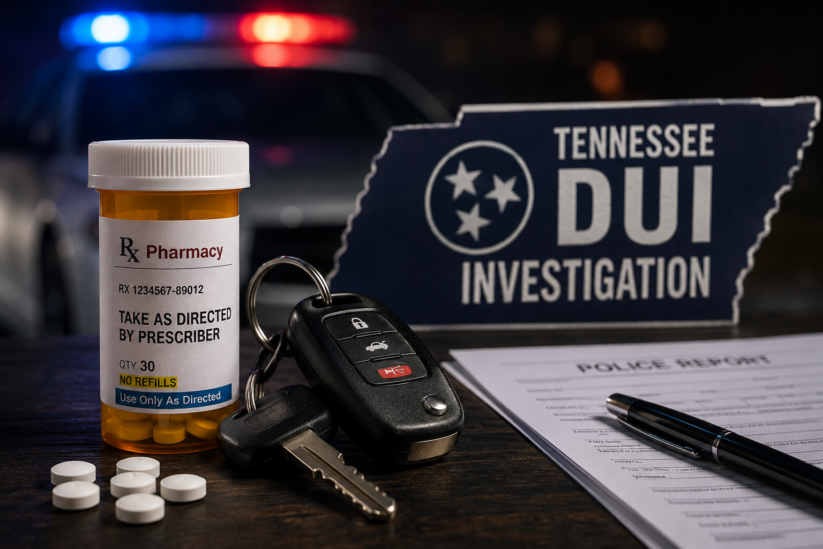
Yes. A person can face a prescription drug DUI in Tennessee even when the medication was lawfully prescribed and taken for a legitimate medical condition. A valid prescription may establish lawful access to the medication, but it does not prevent an impaired-driving allegation. Anyone accused of DUI after taking medication should have the evidence reviewed as part of a broader Tennessee DUI defense.
Taking prescription medication does not automatically make a person impaired. To obtain a conviction under Tennessee law, the State must prove that the person drove or was in physical control of a motor-driven vehicle in a location covered by the DUI statute while under the influence of a drug or other covered substance to the degree that it impaired safe operation.
A medication DUI case can involve the prescribed dosage, the time the medication was taken, tolerance, side effects, interactions with other substances, medical conditions, driving conduct, officer observations, video evidence, and toxicology results. A laboratory report showing that a drug was detected does not answer every question about impairment.
Can Legally Prescribed Medication Result in a Tennessee DUI?
Tennessee Code Annotated § 55-10-401 prohibits driving or being in physical control of an automobile or other motor-driven vehicle while under the influence of an intoxicant, controlled substance, controlled-substance analog, drug, substance affecting the central nervous system, or a combination of covered substances.
The required degree of impairment is one that affects the driver’s ability to operate safely by depriving the driver of the clearness of mind and control that the driver would otherwise possess. The statute applies on public roads and highways, streets and alleys, shopping-center premises, trailer parks, apartment-house complexes, and other premises frequented by the public at large.
The statutory text provides numerical thresholds for alcohol concentration. It does not create one universal concentration at which a prescription medication automatically establishes DUI. A prescription-drug allegation therefore depends on proof of impairment rather than a single drug number.
What Must the State Prove in a Prescription Drug DUI Case?
The State must prove more than possession or use of medication. It must present evidence from which the judge or jury can find that the person was under the influence of a covered substance to the degree required by Tennessee’s DUI statute.
The prosecution may rely on direct and circumstantial evidence. That evidence can include driving conduct, a collision, witness testimony, statements made by the accused, body-camera footage, dash-camera footage, field sobriety performance, medication containers, prescription records, medical records, and toxicology results.
No single item should be viewed in isolation. An officer may describe a person as confused or unsteady, while video may show additional context. Pain, fatigue, anxiety, injury, illness, speech patterns, or physical limitations may also affect how a person appears during a roadside investigation.
The legal issue is not merely whether medication was taken. The issue is whether the complete evidence proves the degree of impairment required by § 55-10-401.
Does Having a Valid Prescription Prevent a DUI Charge?
No. Tennessee Code Annotated § 55-10-411(e) states that lawful entitlement to use a drug or other substance that causes impairment does not constitute a defense to a DUI charge by itself. (Justia Law)
A valid prescription may still be important. It can establish the medication prescribed, authorized dosage, refill history, and length of use. It may also help evaluate an allegation that the person took more medication than prescribed or used it in a way inconsistent with medical instructions.
A prescription does not prove the dose taken before driving, the time of use, or the medication’s effect on that person. Those questions must be examined through the available records and other evidence.
What Does “Physical Control” Mean in Tennessee?
A person does not have to be observed driving for a DUI allegation to arise. Tennessee’s statute also prohibits being in physical control of a covered vehicle while under the influence.
In State v. Lawrence, the Tennessee Supreme Court adopted a totality-of-the-circumstances test for physical control. Relevant facts include the person’s location in relation to the vehicle, the location of the ignition key, if the motor was running, the person’s ability – apart from the alleged intoxication—to direct the vehicle’s use or nonuse, and the extent to which the vehicle could be operated or moved. No one factor automatically determines the result.
This means an allegation may arise from contact with a person in or near a parked vehicle. The State must still prove physical control and every other element of the offense beyond a reasonable doubt.
Does a Positive Blood Test Prove Medication Impairment?
No. A positive result establishes that the laboratory detected a reported drug or metabolite in the sample. It does not, by itself, establish that the person was impaired by that substance at the time of driving.
The National Highway Traffic Safety Administration states that a positive drug result does not by itself indicate impairment, including impairment at the time of a crash. A positive result may reflect medication taken at a therapeutic dose that was not producing an impairing effect at the relevant time.
This is an important difference between prescription-drug toxicology and alcohol testing. The effect of a medication can depend on the drug, dosage, collection time, metabolism, tolerance, individual physiology, other substances, and underlying medical condition.
A breath test showing little or no alcohol does not rule out a medication-related allegation. Breath testing addresses alcohol. Drug analysis may involve a biological sample and laboratory testing. The firm’s discussion of blood testing in Tennessee DUI cases explains additional issues involving the collection and analysis of chemical-test evidence.
What Does a Therapeutic Drug Concentration Mean?
A therapeutic concentration is a range associated with medical use of a particular drug. It is not a legal safe-driving threshold.
A reported therapeutic concentration may be consistent with medical use, but it does not establish that the person followed the prescription, that the medication caused impairment, or that the person was unimpaired. The result must be considered with the collection time, prescribed dosage, dosing history, tolerance, other substances, observed behavior, driving evidence, and testing method.
In State v. Adam Lee Ipock, a State toxicology witness testified that the reported clonazepam level was within the therapeutic range but that clonazepam could still cause drowsiness, delayed reaction time, and difficulty performing divided-attention tasks. The Court of Criminal Appeals found the evidence sufficient to support the convictions, although it described the evidence as not overwhelming. The convictions were reversed because of improper prosecutorial use of prior convictions, not because a therapeutic concentration created a defense.
The case illustrates why neither the prosecution nor the defense should treat the phrase “therapeutic range” as a complete answer to the impairment question.
Five Questions That Can Matter in a Toxicology Review
What Drug or Metabolite Did the Laboratory Identify?
A toxicology report may identify the original medication, one or more metabolites, or both. A metabolite is produced as the body processes a drug.
The presence of a metabolite may confirm prior exposure without establishing that the original drug was producing an impairing effect at the time of driving. The report should be examined to determine precisely what was found.
Was a Numerical Concentration Reported?
Some reports identify only the presence of a substance. Others provide a numerical concentration.
A number can supply additional information, but it still requires interpretation. The concentration may need to be compared with the collection time, laboratory reporting limits, prescription information, toxicology literature, and other evidence.
When Was the Sample Collected?
The time between driving and sample collection can affect the meaning of a result. Drug levels may change as the substance is absorbed, distributed, metabolized, and eliminated.
The concentration at the time of collection is not automatically the concentration that existed at the time of driving. Any opinion attempting to connect the two points in time should have an adequate scientific basis.
Was Medication Given During Emergency Treatment?
Emergency medical personnel and hospital staff may administer pain medication, sedatives, or other drugs after a collision and before a sample is collected. NHTSA has noted that benzodiazepines and opioids may be given as part of emergency treatment and can later appear in drug-test results.
In State v. Richard Faulk, the appellate opinion recounted testimony from a TBI toxicologist that midazolam was not uncommon in blood drawn at a hospital because the medication may be associated with pain relief. The testimony illustrates why treatment records and administration times may matter. The court did not make a finding that every detected dose of midazolam came from hospital treatment.
What Evidence Connects the Result to Impairment?
The toxicology result must be evaluated with the remaining evidence. Relevant information may include the person’s driving, appearance, speech, coordination, video footage, witness accounts, medical history, prescription records, other substances, and expert testimony.
A positive test and an impairment opinion are not the same thing. The basis for any toxicology opinion should be examined carefully.
What Evidence May Police and Prosecutors Use?
A prescription medication DUI investigation may begin after a traffic stop, collision, report from another driver, or contact with a parked vehicle.
An officer may describe lane movement, delayed braking, unusual speed, a traffic violation, difficulty producing documents, slow responses, confusion, unusual speech, or poor balance. Those descriptions should be compared with video and the person’s physical and medical condition.
Field sobriety exercises may also become part of the evidence. These exercises do not identify a particular drug or establish a drug concentration. Their evidentiary value may be affected by the officer’s instructions, roadside conditions, footwear, weather, pain, age, injury, illness, and physical limitations.
Statements about prescription use can also be used. An admission that medication was taken does not establish impairment. Statements about dose, timing, alcohol consumption, warnings, and other substances may still become part of the prosecution or defense.
Can Medical Conditions Be Mistaken for Medication Impairment?
Yes. Confusion, trembling, fatigue, slow responses, poor balance, unusual speech, or difficulty following instructions may have causes unrelated to drug impairment.
A diabetic event, seizure, head injury, neurological condition, panic response, severe pain, sleep deprivation, or physical disability may affect how a person appears during a police encounter. The medication may also have been prescribed to control the condition producing the observed symptoms.
The evidence should distinguish among possible causes rather than assuming that medication was responsible. Medical records, diagnostic testing, emergency treatment, witness observations, and video footage may help explain the person’s condition.
The firm’s article about a medical episode being mistaken for DUI addresses this issue in greater detail.
What Defense Issues May Need to Be Examined?
The review may begin with the legal basis for the traffic stop, detention, arrest, and collection of evidence. A constitutional violation may support a motion to suppress when the facts and applicable law provide a basis for one.
Video should be compared with the written police report. A report may characterize the person as confused, unsteady, or slow to respond. The recording may support the description, contradict it, or show facts that were omitted from the report.
Prescription and pharmacy records may clarify the authorized medication, dosage, refill history, and duration of use. Medical records may document conditions or treatment that provide another explanation for the observed symptoms.
The toxicology evidence may require examination of the substance identified, parent drug and metabolite findings, reported concentration, collection time, testing method, laboratory documentation, measurement limitations, and other substances detected.
Proof of driving or physical control must also be reviewed. When no officer observed the vehicle moving, the location of the accused, position of the keys, vehicle condition, witness testimony, video, and statements attributed to the accused may become important.
What Evidence Should Be Preserved?
Medication containers, prescription instructions, pharmacy records, medical records, hospital discharge papers, laboratory documents, citations, and court notices should be preserved.
The person should document the medication name, prescribed dose, time of use, time driving began, time of police contact, and time a biological sample was collected. Meals, sleep, symptoms, and emergency treatment may also be relevant.
Post-collision records can identify medication administered by emergency personnel or hospital staff before the sample was obtained. Potential video sources should be identified promptly because private security recordings may be overwritten.
A prescribed medication should not be stopped or changed solely because of a criminal charge. Medical questions should be addressed with the prescribing healthcare provider.
What Can Follow a Prescription Drug DUI Conviction?
A prescription-drug DUI is prosecuted under Tennessee’s DUI statutes. A conviction can result in incarceration, a fine, driver-license revocation, probation conditions, an alcohol and drug assessment, and treatment-related requirements.
Tennessee Code Annotated § 55-10-404 provides a one-year driving prohibition for a first DUI conviction, with longer periods for later convictions. Restricted-license and ignition-interlock provisions may also apply under the statutes governing the conviction and driving privileges.
The consequences depend on the offense history and the facts connected to the charge. A collision, injury, child passenger, refusal allegation, alcohol evidence, or additional offense may raise separate sentencing issues.
Frequently Asked Questions About Prescription Drug DUI in Tennessee
Can I Be Charged After Taking Medication Exactly as Prescribed?
Yes. Taking medication according to the prescription does not prevent an arrest or charge if police claim it impaired safe driving. Prescribed use remains relevant to the dosage, toxicology, medical, and factual analysis.
Does a Prescription Prevent a DUI Conviction?
No. Tennessee law states that lawful entitlement to use a covered drug is not a defense by itself. The State must still prove each element of DUI beyond a reasonable doubt.
Does a Positive Drug Test Prove I Was Impaired?
No. It establishes that the reported substance or metabolite was detected. NHTSA distinguishes drug presence from proof of impairment at the time of driving.
Can I Face DUI With a 0.00 Breath-Alcohol Result?
Yes. Tennessee’s DUI statute covers impairment attributed to drugs and substances affecting the central nervous system, not only alcohol. A 0.00 breath result does not resolve a prescription-medication allegation.
Can a Therapeutic Concentration Help the Defense?
It may provide useful context, but it is not an automatic defense. The concentration must be considered with dosage history, tolerance, sample timing, other substances, observed behavior, driving evidence, medical conditions, and toxicology testimony.
Can Over-the-Counter Medication Lead to a DUI Charge?
Yes. Tennessee’s statute is not limited to controlled substances or prescription drugs. It also covers a drug or other substance affecting the central nervous system when the State proves the required degree of impairment.
Charged With DUI After Taking Prescription Medication?
A prescription medication DUI case should not be reduced to the fact that medication was found in a vehicle or detected in a sample. The central questions concern impairment, driving or physical control, the reliability of the investigation, and the relationship between the medication and the person’s condition at the relevant time.
Davis & Hoss, PC represents people facing DUI allegations in Chattanooga and surrounding Tennessee communities. The defense can examine officer observations, body-camera and dash-camera footage, field sobriety evidence, prescription and pharmacy records, medical explanations, toxicology results, and constitutional issues connected to the investigation.
This article is for informational purposes only. It does not provide legal advice for a specific case or create an attorney-client relationship.
Legal review note: The 2025 Tennessee statutory update and the supplied 2026 passed-bills report were checked for later changes affecting this topic. The reviewed materials identify changes involving testing, refusals, interlocks, and DUI sentence commencement, but do not change the core prescription-drug impairment elements discussed above.