
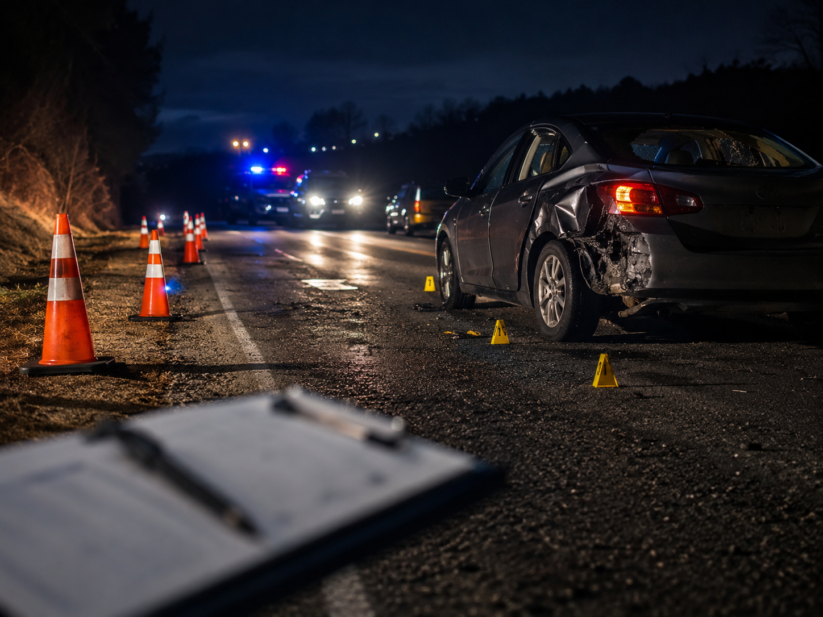
Effective July 1, 2026, Tennessee still classifies leaving the scene of a motor-vehicle accident resulting in death as a Class E felony. The James Bardsley, Jr. Life Protection Act did not raise the offense to a Class D felony. Instead, the law requires at least one year of confinement, requires that mandatory one-year portion to be served at 100%, and imposes a fine of $5,000 to $10,000. A person facing an investigation should consider obtaining defense for serious Tennessee traffic charges before giving a detailed statement or responding to investigative requests.
What Changed on July 1, 2026
The James Bardsley, Jr. Life Protection Act, enacted as Public Chapter 1072, changed the punishment for the fatal leaving-the-scene offense under Tenn. Code Ann. § 55-10-101.
For a qualifying offense committed on or after July 1, 2026, the sentence must include at least one year of confinement. The defendant must serve that mandatory one-year portion at 100%.
The Act also requires a fine of no less than $5,000 and no more than $10,000.
The final adopted Senate amendment confirms that lawmakers retained the Class E felony classification while adding the mandatory confinement and fine provisions.
What the Final Law Did Not Change
The final law did not make leaving the scene of a fatal accident a Class D felony.
The introduced version of SB1602/HB1967 proposed raising the offense from a Class E felony to a Class D felony. That proposal was not included in the enacted law.
The introduced bill also proposed raising the offense involving an injury accident from a Class A misdemeanor to a Class E felony. That proposal was not part of the controlling change enacted through Public Chapter 1072.
The Tennessee General Assembly bill record for SB1602/HB1967 documents the legislation’s history and the amendments adopted before enactment. Descriptions of the introduced bill should not be treated as statements of the final law.
Existing law also directs the Tennessee Commissioner of Safety to revoke the driver license, permit, or nonresident operating privilege of a person convicted under Tenn. Code Ann. § 55-10-101. Public Chapter 1072 did not create or amend that separate consequence.
When Public Chapter 1072 Applies
Public Chapter 1072 took effect July 1, 2026. It applies to qualifying offenses committed on or after that date.
The relevant date is the date of the alleged offense. A later arrest, indictment, plea, trial, or sentencing hearing does not make conduct occurring before July 1, 2026, subject to the new penalty.
This effective-date distinction may be important when an accident occurred before July 1, but the investigation or criminal case continued after the new law took effect.
Tennessee’s Legal Duties After an Accident Involving Death
Tenn. Code Ann. § 55-10-101 requires a driver involved in an accident resulting in injury or death to stop immediately at the scene or as close to the scene as possible.
A driver who does not stop at the exact location must return to the scene and remain there until completing the duties required by Tenn. Code Ann. § 55-10-103.
Section 55-10-103 requires the driver to provide the driver’s name, address, and vehicle-registration number. Upon request and if available, the driver must also display a driver’s license to the person struck or to the driver, occupant, or person attending a vehicle involved in the accident.
The driver must render reasonable assistance to an injured person. That duty includes transporting the person, or arranging transportation, for medical treatment when treatment appears necessary or when the injured person requests assistance.
These duties concern the driver’s conduct after the accident. They do not establish who caused the collision or who was legally responsible for the death.
The “Knew or Reasonably Should Have Known” Requirement
The fact that an accident resulted in death does not, by itself, establish the Class E felony offense.
The State must prove that the accused person:
- Was involved in a motor-vehicle accident;
- Failed to stop or comply with the applicable statutory duties; and
- Knew or reasonably should have known that death resulted from the accident.
Actual knowledge may be addressed through direct evidence, including statements or communications showing awareness that someone had died.
Knowledge may also be addressed through circumstantial evidence. Relevant evidence may include the force and circumstances of the collision, what the driver could see or hear, visible injuries, vehicle damage, witness communications, 911 calls, and statements or conduct after the accident.
The statute does not create a fixed checklist for proving knowledge. No single item of evidence automatically establishes that a person knew or reasonably should have known that death resulted.
The meaning of being “involved” in an accident may also become disputed. Tennessee appellate authority has held that physical contact is not always required. In State v. Deborah Leigh Goins, the Tennessee Court of Criminal Appeals considered evidence connecting the defendant’s driving conduct to the crash even though the vehicles did not collide.
That decision does not mean that a nearby driver, witness, or passer-by is legally involved merely because the person was present near an accident.
The New Mandatory Confinement and Fine
Tenn. Code Ann. § 40-35-111 provides a sentencing range of one to six years for a Class E felony.
Public Chapter 1072 adds a more specific requirement for this fatal leaving-the-scene offense. The sentence must include at least one year of actual confinement, and the defendant must serve that mandatory one-year portion at 100%.
The law does not state that every part of a sentence longer than one year must be served at 100%. The precise requirement is that the mandatory one-year minimum must be served at 100%.
The Act also creates an offense-specific fine of $5,000 to $10,000. That specific fine applies to this offense rather than the lower general Class E felony fine provision.
Leaving the Scene Versus Causing the Fatal Accident
Leaving the scene concerns what a driver did after becoming involved in an accident and what the driver knew or reasonably should have known about the resulting death.
The charge does not automatically establish that the accused caused the collision. It also does not automatically establish that the accused caused the death.
Fault for the underlying accident and compliance with post-accident duties are separate legal questions.
A person may dispute responsibility for causing the crash while also facing an allegation that the person failed to stop, provide information, remain at the scene, or render reasonable assistance.
The State must prove the elements of the leaving-the-scene charge rather than relying only on the fact that a fatal accident occurred.
Leaving the Scene Versus Vehicular Homicide
Leaving the scene of a fatal accident and vehicular homicide are separate criminal offenses.
The leaving-the-scene statute focuses on post-accident duties and the accused person’s knowledge that death resulted.
Vehicular homicide under Tenn. Code Ann. § 39-13-213 concerns the reckless killing of another person caused through the operation of a motor vehicle under the circumstances identified in that statute.
A leaving-the-scene allegation does not prove vehicular homicide. A vehicular-homicide allegation also does not automatically prove that the driver failed to stop or comply with the duties required by Tenn. Code Ann. § 55-10-103.
Each offense requires proof of its own statutory elements. Davis & Hoss provides separate information about Tennessee vehicular homicide charges.
Other Charges That May Arise From the Same Accident
The evidence from one accident may support separate criminal allegations.
Possible charges may include reckless driving, driving under the influence, driving on a revoked or suspended license, vehicular homicide, or another offense connected to the operation of the vehicle.
None of these charges follows automatically from a death or an accusation that a driver left the scene. The prosecution must prove the elements of each charged offense.
Tenn. Code Ann. § 55-10-101 also contains a consecutive-sentencing provision. When the same course of conduct results in a conviction for the fatal leaving-the-scene offense and a conviction for vehicular assault, vehicular homicide, or aggravated vehicular homicide, the sentence for leaving the scene must run consecutively to the sentence for the applicable assault or homicide offense.
Evidence That May Matter in the Investigation
A fatal-crash investigation may involve vehicle damage, scene measurements, crash-reconstruction analysis, surveillance recordings, witness observations, 911 communications, phone-location records, vehicle data, medical evidence, post-accident conduct, and statements.
Each source of evidence has limitations.
A surveillance recording may capture only one angle or a limited part of the incident. A witness may have had a restricted view or may have observed the event under difficult conditions.
Phone-location information may place a device within an area without establishing who possessed or used it. Vehicle data may require technical interpretation and may not answer every disputed question.
Medical evidence may help establish the cause or timing of death, but it does not automatically establish what a driver knew at the time of departure.
Statements and post-accident conduct may also require context. No single category of evidence automatically proves guilt.
Legal Issues a Defense Attorney May Examine
A defense attorney may examine the identity of the driver, the accused person’s involvement in the accident, compliance with the statutory duties, and the evidence offered to prove knowledge that death resulted.
The review may also address the reliability of witness identification, the accuracy of crash-reconstruction conclusions, the completeness of surveillance evidence, and the interpretation of phone or vehicle data.
Statements can raise separate legal issues. Counsel may examine the circumstances of questioning, the wording and context of the statement, and whether the statement is admissible.
Searches of a vehicle, phone, home, or electronic account may require analysis of consent, search warrants, the scope of the search, and constitutional protections.
A defense must be grounded in the evidence and governing law. Panic, shock, or fear does not automatically excuse leaving the scene.
Steps to Take After Learning That Police Are Investigating
A person who learns that law enforcement is investigating a fatal crash should seek legal advice before giving a substantive statement.
An attorney can communicate with investigators, clarify the person’s status, and advise how to respond to a request for an interview, vehicle inspection, evidence, surrender, or compliance with a warrant.
Do not repair, sell, conceal, transfer, alter, or destroy a vehicle or other potential evidence.
Do not delete messages, location history, photographs, recordings, call records, or account information.
Preserve receipts, communications, photographs, documents, and other records that may help establish the timeline.
Avoid discussing the accident on social media or with people outside the attorney-client relationship.
Davis & Hoss provides separate guidance about turning yourself in after a fatal crash. That resource addresses surrender-related concerns without duplicating the penalty issue discussed here.
Understanding Tennessee’s 2026 Penalty Change
Tennessee’s 2026 change is significant, but it must be stated precisely.
Leaving the scene of an accident resulting in death remains a Class E felony. For a qualifying offense committed on or after July 1, 2026, the sentence must include at least one year of confinement served at 100%, along with a fine of $5,000 to $10,000.
A fatal accident is a grave event. It does not remove the presumption of innocence, establish who caused the collision, or relieve the State of its burden to prove every element of the charged offense.
Davis & Hoss represents people facing serious motor-vehicle investigations and other matters involving Tennessee criminal defense services. Contact the firm to discuss the allegation, the evidence, and the legal issues that may affect the case.
Frequently Asked Questions
Did leaving a fatal accident become a Class D felony in Tennessee?
No. The introduced version of SB1602/HB1967 proposed changing the offense from a Class E felony to a Class D felony, but that proposal was not enacted.
Public Chapter 1072 retains the Class E felony classification and adds at least one year of confinement served at 100% and a fine of $5,000 to $10,000.
What penalty changed on July 1, 2026?
For a qualifying offense committed on or after July 1, 2026, the sentence must include at least one year of confinement.
That mandatory one-year portion must be served at 100%. The law also requires a fine ranging from $5,000 to $10,000.
What does “knew or reasonably should have known” mean?
It is the knowledge element the State must prove for the Class E felony offense.
Evidence may include what the driver could observe, the circumstances of the collision, visible injuries, vehicle damage, witness communications, 911 calls, and statements or conduct after the accident.
No single fact automatically proves this element.
Is leaving the scene the same as vehicular homicide?
No. Leaving the scene concerns post-accident duties and knowledge that death resulted.
Vehicular homicide concerns a reckless killing caused through motor-vehicle operation under the circumstances listed in Tenn. Code Ann. § 39-13-213.
Each offense has separate statutory elements.
Can someone be charged even if they did not cause the crash?
Yes. The leaving-the-scene statute does not require the State to prove that the accused caused the initial collision.
The State must still prove that the person was involved in the accident, failed to stop or complete the required duties, and knew or reasonably should have known that death resulted.