
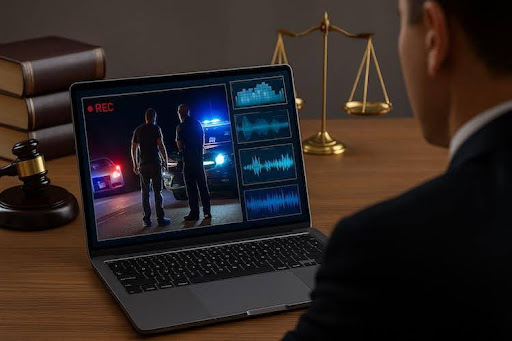
Video from a Tennessee traffic stop can look decisive, until it’s tested closely.
A stumble on camera or a slurred word may seem incriminating, but technology now allows lawyers to measure accuracy instead of making assumptions.
Across the United States, and increasingly in Tennessee, ai video evidence analysis helps defense attorneys evaluate police dashcam and bodycam recordings for reliability. These tools analyze metadata, frame rates, and compression to identify missing data or altered timestamps that can change what a jury sees.
The Problem: When Police Video Isn’t as Clear as It Looks
In DUI prosecutions, video evidence has become a cornerstone. Police vehicles and body-worn cameras capture field sobriety tests, driver interactions, and statements made at the roadside.
Yet, as national research from the U.S. Department of Justice’s Body-Worn Camera Program shows, video footage is not always a perfect record. Lighting, camera placement, and frame rate variations can distort what actually happened.
In Tennessee, these recordings must still be authenticated before admission. Under Tenn. R. Evid. 901, the proponent must produce evidence “sufficient to support a finding that the matter is what its proponent claims.”
Chain of custody for digital files is governed by the same principle outlined in Tenn. R. Evid. 1001–1003.
How AI Tools Analyze Dashcam and Bodycam Recordings
1. File Integrity and Metadata Verification
AI-powered software reads embedded data fields such as camera model, firmware version, GPS coordinates, and creation timestamps. These video metadata analysis tools detect when a file was exported or re-encoded. Discrepancies can reveal gaps in the record — information that matters under the rules of evidence.
2. Pixel and Compression Testing
Programs like Amped FIVE or Cognitech Video Investigator map macroblocks and compression noise to spot areas that have been altered or compressed multiple times (Amped Software features). A change in compression does not prove tampering but does raise questions for cross-examination.
3. Audio and Synchronization
Bodycam footage AI review tools can align audio to visual frames and detect when recording devices fell out of sync. If the sound lags behind mouth movement, a judge may decide that tone or slurred speech is less trustworthy than it appears.
4. Deepfake and Authenticity Scanning
Although rare in DUI cases, deepfake detection legal defense software tests footage for artificial insertion or pixel-level anomalies. Authenticating that a recording has not been synthetically altered strengthens the credibility of the defense review.
5. Scene Re-Creation and Measurement
Some platforms support photogrammetry — measurement from multiple camera angles to estimate distances, light sources, and sightlines. This form of ai reconstruction of DUI traffic stops can show that apparent swaying was caused by camera angle or road slope rather than impairment. It is not a true 3-D model, but a quantified analysis of what each camera could see.
How Courts Evaluate AI Findings
Under Tenn. R. Evid. 702, expert testimony is admissible if scientific, technical, or specialized knowledge will substantially assist the trier of fact and if the witness is qualified. Tennessee courts apply a gatekeeper standard similar to Daubert v. Merrell Dow Pharmaceuticals, 509 U.S. 579 (1993).
Therefore, findings from AI forensic video tools must be presented through qualified experts who can explain methodology, error rates, and reliability. AI output alone is not evidence; it supports expert testimony subject to cross-examination.
AI and Tennessee’s Evolving DUI Laws
Tennessee has recently expanded testing methods for impaired driving. Under Public Chapter 403 (2025) amending T.C.A. § 55-10-406, law enforcement officers may administer an “oral fluids test” to determine impairment. The law became effective May 5, 2025, making oral-fluid results admissible in the same manner as blood tests.
Separately, Tennessee’s implied consent statute still permits license revocation for refusal to submit to testing. Under T.C.A. § 55-10-407, a first-time refusal results in a one-year revocation; effective Jan 1, 2026, the revocation period for certain blood-draw refusals will increase to 18 months per Public Chapter 403.
Common Findings in AI Video Reviews
Missing Frames or Rate Drops:
An automated frame-by-frame review may show frame-rate changes during field tests. If a clip drops from 30 to 15 frames per second, movements can look longer than they were. A report quantifies that difference so jurors see time accurately.
Audio Drift:
AI alignment tools can prove that audio recorded on a bodycam microphone drifted from video by several milliseconds, which can affect tone perception.
Metadata Inconsistencies:
A file created after the incident or with a non-standard codec may indicate an export or conversion by the agency. Courts require documentation of each transfer to maintain authenticity (see Tenn. R. Evid. 1002–1003).
Lighting and Perspective:
AI photogrammetry helps measure glare from patrol lights or headlights. In some cases, these measurements show that what looked like a stumble was camera distortion, not loss of balance.
Penalties and Procedures in Tennessee DUI Cases
Because video evidence often influences sentencing, it’s important to know the statutory framework.
- First Offense: minimum 48 hours jail, up to 11 months 29 days; license revocation 1 year. (T.C.A. § 55-10-402)
- Second Offense: minimum 45 days jail; revocation 2 years. (§ 55-10-403)
- Third Offense: minimum 120 days jail; revocation 6 years.
- Fourth or Subsequent: Class E felony, minimum 150 consecutive days in jail, possible sentence up to 6 years. (§ 55-10-401(g))
A sixth or subsequent DUI may qualify as a Class C felony with 3–15 years imprisonment and a fine up to $15,000 under enhancement rules reported by the National College for DUI Defense.
How AI Supports Cross-Examination
During trial, defense counsel can compare AI measurements with officer testimony to highlight inconsistencies. For example, if metadata shows the camera was not activated until after the stop, a lawyer may ask why the earliest interactions were not recorded. Under the rules of evidence, the goal is not to accuse but to test reliability.
Cross-examination based on law enforcement video scrutiny can also identify procedural errors such as skipped instructions in standardized field sobriety tests, providing a basis for suppression or reasonable doubt.
Ethical and Procedural Limits
While AI tools are powerful, they must comply with privacy and discovery rules. Digital evidence handling guidelines from the U.S. Department of Justice require that lawyers document hash values and preserve original files in read-only form. A defense team using dui defense ai technology should maintain a clear chain of custody log so results stand up under Tenn. R. Evid. 901(b)(9).
Tennessee Practice Tip
Many law-enforcement agencies in Hamilton County and Chattanooga now use both dashcams and body-worn cameras. That means defense lawyers can request multiple angles for the same event and use ai evidence verification in dui to synchronize them before trial.
The defense should request original native files, not emailed copies. Each copy creates a new metadata trail, and only original exports can be authenticated under Tennessee procedure.
Logical Next Step for the Reader
If you are facing a DUI charge in Tennessee and the video looks damaging, ask your attorney about technical review options. AI analysis can help measure accuracy — not just show a recording. You can read more about defense approaches on the firm’s DUI Defense Services page.
FAQ
- What does AI video analysis do in a Tennessee DUI case?
It measures timing, lighting, and metadata in dashcam and bodycam recordings to see if the footage accurately reflects events. The results can be used by experts under Tenn. R. Evid. 702.
- Can AI prove tampering or deepfakes?
It can detect anomalies and compression patterns suggesting editing, but courts require expert testimony to interpret those results. Findings support arguments under Tenn. R. Evid. 901.
- Are AI reports automatically admissible?
No. They must be introduced by qualified experts and meet the standards of Daubert and Tennessee’s evidentiary rules, including Tenn. R. Evid. 702 and Tenn. R. Evid. 901.